Abstract
The present study assesses digital literacy, technology acceptance, and online learning readiness among teachers and students in higher education institutions. Digital literacy refers to the ability to access, evaluate, use, and create information through digital technologies. Technology acceptance reflects the willingness of teachers and students to adopt digital tools based on usefulness, ease of use, confidence, and attitude. Online learning readiness includes technical skills, self-directed learning ability, internet access, device availability, motivation, and institutional support. The study examines how digital competence and acceptance of technology influence participation in online learning environments. It also highlights challenges such as digital divide, lack of training, poor connectivity, limited infrastructure, and resistance to technology. The study concludes that higher levels of digital literacy and positive technology acceptance can improve online learning readiness, teaching effectiveness, learner engagement, and academic performance in higher education.
- Digital Literacy
- Technology Acceptance
- Online Learning Readiness
- Teachers
- Students
- Higher Education
- Digital Learning
Introduction#
Digital literacy, technology acceptance and online learning readiness have become essential components of higher education in the present digital age. Higher education institutions are increasingly using digital tools, online platforms, learning management systems, virtual classrooms, e-resources, digital libraries and video conferencing applications for teaching, learning, assessment and academic communication. The rapid growth of educational technology has changed the traditional classroom-based model into a more flexible, technology-supported and learner-centred system.
Digital literacy refers to the ability to use digital devices, internet resources and online platforms effectively and responsibly. It includes skills such as searching information, evaluating online content, using educational applications, communicating through digital tools, creating digital content and maintaining cyber safety. Teachers with strong digital literacy can design better online lessons, use multimedia resources and manage virtual classrooms effectively. Similarly, digitally literate students can access study material, participate in online discussions, submit assignments and learn independently.
Technology acceptance is another important factor in digital education. It refers to the willingness and positive attitude of teachers and students toward using technology for academic purposes. Even when digital tools are available, effective use depends on whether users find them useful, easy to operate and beneficial for teaching-learning activities. If teachers and students are confident and motivated to use technology, online education becomes more effective. However, fear of technology, lack of training, resistance to change and low confidence may reduce the use of digital platforms.
Online learning readiness refers to the preparedness of teachers and students to participate successfully in online learning environments. It includes availability of devices, internet connectivity, digital skills, self-discipline, motivation, time management, communication ability and institutional support. Students need readiness for self-directed learning, while teachers need readiness for online content delivery, digital assessment and student engagement. Without proper readiness, online learning may become difficult and ineffective.
The relationship among digital literacy, technology acceptance and online learning readiness is highly significant. Digital literacy provides the basic skills required to use online platforms. Technology acceptance develops willingness and confidence to adopt digital tools. Online learning readiness reflects the practical ability to engage in digital teaching and learning. Thus, these three factors together determine the success of online education in higher education institutions.
Higher education institutions have an important role in promoting digital readiness. They must provide ICT infrastructure, internet facilities, teacher training, student orientation, technical support and user-friendly learning platforms. Digital libraries, e-content, online assessment tools and academic management systems can improve the quality of higher education. At the same time, institutions must address challenges such as unequal access to devices, poor connectivity, lack of digital skills and cyber security concerns.
Digital Literacy as a Core Competency in Higher Education#
Digital literacy has emerged as a fundamental competency in contemporary higher education due to the rapid integration of information and communication technologies into teaching, learning, research, and academic administration. The digital transformation of education has significantly altered traditional pedagogical approaches, making digital competencies essential for both teachers and students. In the twenty-first century, higher education institutions increasingly rely on digital platforms, virtual learning environments, online resources, and technology-mediated communication to facilitate educational processes. Consequently, digital literacy has become a prerequisite for effective participation, academic success, and lifelong learning in higher education.
Digital literacy broadly refers to the ability to access, evaluate, create, communicate, and manage information effectively through digital technologies. It extends beyond basic technical skills and encompasses cognitive, social, ethical, and critical dimensions associated with the use of digital tools and environments. Digitally literate individuals possess the knowledge, skills, attitudes, and competencies necessary to navigate complex digital ecosystems responsibly and efficiently.
The concept of digital literacy has evolved considerably since its initial formulation. Early conceptualizations primarily emphasized technical proficiency in operating computers and digital devices. However, contemporary perspectives recognize digital literacy as a multidimensional construct involving information literacy, media literacy, communication skills, critical thinking, problem-solving abilities, and ethical awareness. Thus, digital literacy encompasses not only the ability to use technology but also the capacity to critically evaluate digital information, create digital content, collaborate online, and engage responsibly within digital environments.
In higher education, digital literacy plays a crucial role in facilitating teaching and learning processes. Teachers require digital competencies to design, deliver, and assess educational content effectively in technology-enhanced environments. Digital literacy enables educators to integrate multimedia resources, learning management systems, virtual classrooms, online assessment tools, and interactive technologies into instructional practices. Teachers possessing strong digital competencies are better equipped to create engaging, learner-centred, and innovative educational experiences.
Similarly, students require digital literacy to participate effectively in contemporary educational environments. Digitally literate students can access online learning materials, conduct academic research, communicate with instructors and peers, participate in virtual discussions, submit assignments electronically, and engage in collaborative learning activities. Such competencies support independent learning, academic achievement, and successful adaptation to digitally mediated educational contexts.
Information literacy constitutes one of the most important dimensions of digital literacy in higher education. Information literacy refers to the ability to identify information needs, locate relevant sources, evaluate information critically, and utilize information ethically and effectively. The proliferation of digital information resources has created unprecedented access to knowledge; however, it has also increased challenges associated with information overload, misinformation, and questionable source credibility. Consequently, students and educators must develop critical information evaluation skills to distinguish reliable academic resources from inaccurate or misleading information.
Media literacy represents another significant component of digital literacy. Media literacy involves understanding, analyzing, interpreting, and creating messages across various digital media formats. In contemporary digital environments, individuals are continuously exposed to diverse forms of media content, including social media, websites, videos, podcasts, blogs, and multimedia presentations. Media literacy enables individuals to critically examine media messages, recognize biases, evaluate credibility, and communicate effectively using multiple digital formats.
Communication and collaboration skills are equally important dimensions of digital literacy in higher education. Digital technologies facilitate communication among students, teachers, researchers, and academic communities across geographical boundaries. Effective participation in online learning environments requires competencies related to virtual communication, digital etiquette, collaborative problem-solving, and teamwork. Learning management systems, discussion forums, video conferencing platforms, and collaborative software tools enable interactive and collaborative learning experiences. Therefore, digital communication competencies are essential for academic engagement and professional development.
Content creation skills have gained increasing importance within higher education contexts. Contemporary educational approaches emphasize active knowledge construction and student participation in content creation processes. Digitally literate individuals should be capable of producing and sharing digital content using various technologies and media formats. Such skills include creating presentations, multimedia projects, blogs, videos, podcasts, digital portfolios, and other educational materials. Content creation competencies support creativity, innovation, critical thinking, and knowledge dissemination.
Ethical and responsible technology use constitutes another critical aspect of digital literacy. Digital environments present numerous ethical challenges related to privacy, intellectual property, plagiarism, cybersecurity, digital citizenship, and online behaviour. Higher education institutions must therefore promote ethical awareness and responsible digital practices among students and teachers. Digital literacy includes understanding copyright regulations, respecting intellectual property rights, protecting personal information, maintaining academic integrity, and engaging respectfully within online communities.
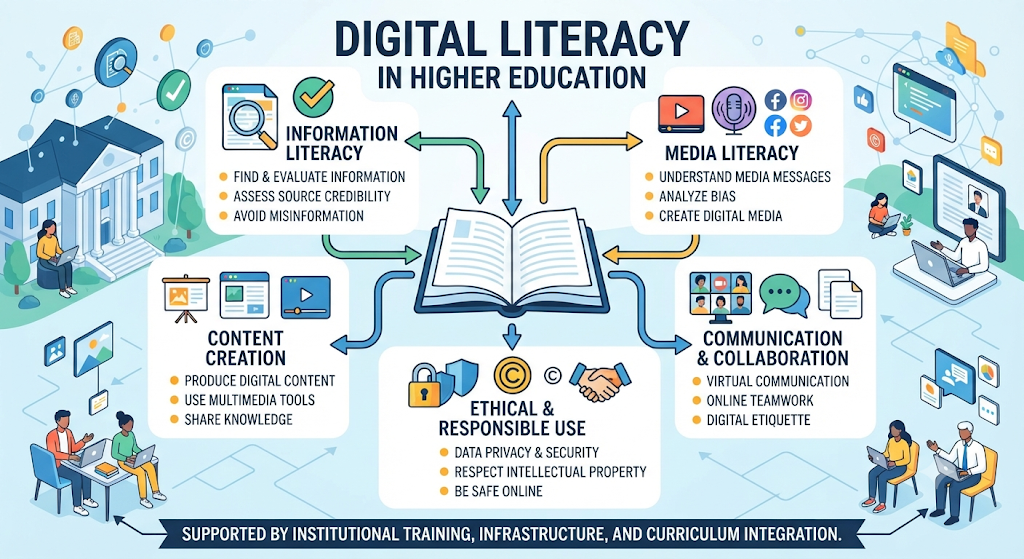
Cybersecurity awareness has become increasingly important as educational institutions expand their digital infrastructures. Students and educators frequently utilize online platforms, cloud services, and digital communication systems that involve sensitive personal and academic information. Digital literacy therefore includes knowledge regarding password security, data protection, phishing prevention, safe internet practices, and responsible use of digital technologies. Such competencies contribute to secure and trustworthy digital learning environments.
The integration of online and blended learning models has further increased the significance of digital literacy in higher education. The COVID-19 pandemic accelerated the adoption of online education globally, highlighting substantial variations in digital competencies among students and educators. Many institutions encountered challenges associated with inadequate digital skills, limited technological preparedness, and unequal access to digital resources. These experiences underscored the necessity of strengthening digital literacy as a core educational competency.
Digital literacy also contributes significantly to lifelong learning and employability. Contemporary labour markets increasingly demand employees who possess advanced digital competencies and adaptability to technological change. Employers expect graduates to demonstrate proficiency in digital communication, information management, collaboration technologies, and problem-solving within technology-rich environments. Consequently, higher education institutions must equip students with digital competencies necessary for professional success and continuous learning throughout their careers.
Several theoretical frameworks have been proposed to conceptualize digital literacy in educational contexts. The European Commission's Digital Competence Framework (DigComp) identifies key competency areas including information and data literacy, communication and collaboration, digital content creation, safety, and problem-solving. Similarly, the Technological Pedagogical Content Knowledge (TPACK) framework emphasizes the integration of technological, pedagogical, and disciplinary knowledge for effective teaching with technology. Such frameworks provide valuable guidance for curriculum development and competency assessment.
Despite its importance, significant disparities in digital literacy persist among students and educators. Factors such as socio-economic background, geographical location, access to technology, prior educational experiences, age, and institutional support influence digital competency development. The digital divide, characterized by unequal access to digital technologies and skills, remains a significant challenge in higher education, particularly in developing countries. Addressing these disparities is essential for ensuring equitable educational opportunities.
Higher education institutions play a crucial role in promoting digital literacy. Institutions can enhance digital competencies by providing technological infrastructure, professional development programmes, digital skills training, technical support services, and curriculum integration initiatives. Faculty development programmes focusing on educational technology integration and student orientation programmes addressing digital competencies contribute significantly to digital literacy enhancement.
A multidisciplinary perspective enriches understanding of digital literacy because the concept intersects with education, information science, communication studies, psychology, sociology, and computer science. Educational research examines pedagogical applications; information science focuses on information management; communication studies investigate digital interaction; psychology explores cognitive processes; and sociology analyzes digital inequalities and social implications.
Technology Acceptance among Teachers and Students#
Technology acceptance refers to the willingness of teachers and students to adopt and use digital tools for academic purposes. In higher education, technology acceptance is important because online learning, digital assessment, virtual classrooms, e-resources and learning management systems can be effective only when users are ready and willing to use them. Availability of technology alone is not enough; its successful use depends on users’ attitude, confidence, perceived usefulness and ease of operation.
Among teachers, technology acceptance influences teaching methods, classroom management and academic communication. Teachers who accept technology positively are more likely to use digital presentations, online quizzes, video lectures, e-content, virtual discussions and digital assessment tools. They can make teaching more interactive, flexible and learner-centred. However, teachers who lack confidence or training may hesitate to use digital platforms, even when such facilities are available.
Among students, technology acceptance affects participation in online learning and academic engagement. Students who believe that digital tools are useful and easy to use are more likely to attend online classes, access study materials, submit assignments and participate in discussions. Positive technology acceptance improves self-directed learning and academic confidence. On the other hand, fear of technology, poor digital skills, lack of devices and internet problems may reduce students’ participation.
The Technology Acceptance Model explains that perceived usefulness and perceived ease of use are major factors influencing technology adoption. If teachers and students feel that technology improves learning and is simple to operate, they are more likely to accept it. Therefore, higher education institutions must provide training, technical support, user-friendly platforms and motivation to improve technology acceptance.
Technology acceptance also depends on institutional culture. Supportive administration, availability of ICT infrastructure, digital resources, peer support and positive leadership encourage teachers and students to adopt technology. Regular workshops, orientation programmes and hands-on training can reduce resistance and increase confidence.
Online Learning Readiness and Academic Engagement#
Online learning readiness refers to the preparedness of teachers and students to participate effectively in digital learning environments. It includes digital skills, device availability, internet connectivity, motivation, self-discipline, time management, communication ability and institutional support. In higher education, online learning readiness is essential because digital education requires active participation, independent learning and continuous use of technology.
For students, online learning readiness means the ability to attend virtual classes, access e-resources, submit assignments, participate in discussions and manage learning independently. Students who are ready for online learning show better concentration, confidence and academic responsibility. They can plan their study schedule, use digital platforms properly and communicate with teachers when they face difficulties.
For teachers, online learning readiness includes the ability to prepare digital content, conduct online classes, use learning management systems, create online assessments and engage students through interactive tools. Teachers who are ready for online teaching can make virtual classes more effective, organized and participatory.
Academic engagement is closely linked with online learning readiness. Engaged students participate actively in learning activities, ask questions, complete assignments, attend classes regularly and remain motivated. If students lack online readiness, they may feel confused, disconnected or passive during digital learning. Similarly, if teachers are not ready, online classes may become one-way, less interactive and ineffective.
Online learning readiness also depends on emotional and behavioural factors. Students need self-motivation, patience and responsibility because online learning provides more freedom but also demands greater self-control. Distractions at home, poor internet, lack of interaction and screen fatigue may reduce engagement. Therefore, online learning requires both technical readiness and psychological readiness.
Higher education institutions can improve online learning readiness through orientation programmes, digital literacy training, technical support, user-friendly platforms, e-content availability and regular feedback systems. Interactive teaching methods such as quizzes, discussion forums, breakout rooms, online presentations and collaborative activities can increase academic engagement.
Institutional Support, Digital Infrastructure, and Challenges in Online Education#
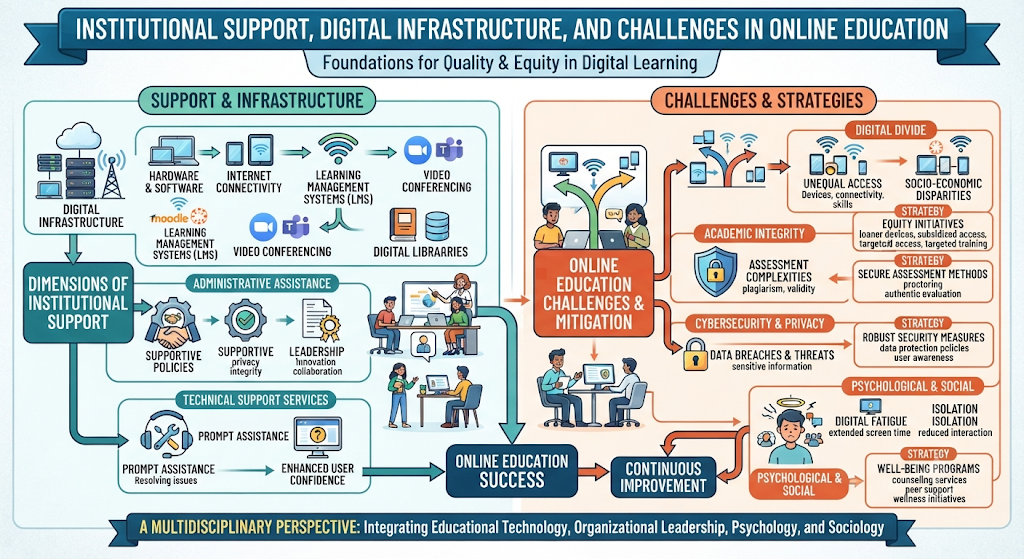
Institutional support and digital infrastructure are fundamental requirements for the successful implementation of online education in higher education institutions. The effectiveness of digital learning depends not only on the readiness and competencies of teachers and students but also on the availability of adequate technological resources, administrative support, training opportunities, and supportive institutional policies. Higher education institutions play a crucial role in creating enabling environments that facilitate effective online teaching and learning experiences. Consequently, understanding institutional support mechanisms, digital infrastructure requirements, and challenges associated with online education is essential for ensuring quality and equitable educational outcomes.
Institutional support refers to the assistance, resources, policies, and services provided by educational institutions to facilitate digital teaching and learning processes. Effective institutional support encompasses technological infrastructure, administrative assistance, professional development programmes, technical support services, digital learning resources, and organizational policies that encourage technology integration. Institutions that provide comprehensive support systems are better positioned to promote successful adoption of online education and enhance educational quality.
One of the most important components of institutional support is the provision of robust digital infrastructure. Digital infrastructure refers to the technological foundation necessary for delivering and supporting online education. It includes hardware resources, software applications, internet connectivity, network systems, servers, cloud-based platforms, and digital communication technologies. Reliable digital infrastructure enables uninterrupted access to educational resources and facilitates effective interaction among teachers and students.
Internet connectivity represents a critical element of digital infrastructure. High-speed and stable internet access is essential for participating in virtual classrooms, accessing online learning materials, conducting academic research, and engaging in collaborative activities. Inadequate internet connectivity may disrupt teaching-learning processes, reduce student participation, and negatively affect educational outcomes. Consequently, institutions must ensure reliable internet facilities both on campus and, where possible, support off-campus access for students and faculty members.
Learning Management Systems (LMS) constitute another essential component of digital infrastructure in higher education. LMS platforms such as Moodle, Blackboard, Canvas, and Google Classroom facilitate the organization, delivery, and management of online educational activities. These platforms enable teachers to upload learning materials, administer assessments, monitor student progress, facilitate discussions, and provide feedback. Learning management systems also support asynchronous learning by allowing students to access educational resources at convenient times.
Video conferencing technologies have become indispensable tools for synchronous online education. Platforms such as Zoom, Microsoft Teams, Google Meet, and Webex enable real-time communication and interaction among teachers and students. Virtual classrooms facilitate lectures, discussions, presentations, collaborative learning activities, and academic consultations. Effective utilization of such technologies requires appropriate technical infrastructure, user competencies, and institutional support.
Digital libraries and electronic learning resources further strengthen online education. Access to e-books, academic journals, databases, multimedia resources, and digital repositories supports independent learning, research activities, and knowledge acquisition. Institutions that invest in comprehensive digital resource collections enhance academic opportunities and facilitate scholarly engagement within online learning environments.
Technical support services constitute another important dimension of institutional support. Teachers and students frequently encounter technical challenges related to software usage, connectivity issues, hardware malfunctions, and platform navigation. Dedicated technical support teams assist users in resolving such difficulties and ensure continuity of educational activities. Prompt and effective technical assistance reduces frustration, enhances user confidence, and promotes successful technology adoption.
Professional development and training programmes are equally essential for effective online education. Many educators may lack adequate digital competencies or pedagogical knowledge necessary for online teaching. Institutions must therefore provide continuous professional development opportunities focusing on educational technology integration, online instructional design, digital assessment strategies, and virtual classroom management. Faculty training programmes enhance teaching effectiveness and support successful implementation of online education.
Similarly, student orientation programmes contribute significantly to online learning success. Students require guidance regarding digital platform usage, online communication practices, academic integrity, time management, and self-directed learning strategies. Orientation initiatives enhance students' digital competencies and facilitate adaptation to online learning environments.
Institutional policies and leadership also influence the effectiveness of online education. Clear policies regarding online teaching standards, assessment procedures, attendance requirements, academic integrity, data privacy, and technology usage provide essential guidance for educators and learners. Supportive leadership that promotes innovation, collaboration, and continuous improvement contributes significantly to successful digital transformation within higher education institutions.
Despite numerous opportunities, online education faces several significant challenges. One of the most prominent challenges is the digital divide. The digital divide refers to inequalities in access to digital technologies, internet connectivity, and digital skills among individuals and communities. Socio-economic disparities, geographical differences, and infrastructural limitations often result in unequal educational opportunities. Students from economically disadvantaged backgrounds or rural areas may experience limited access to devices and reliable internet services, thereby affecting their participation and academic achievement.
Assessment and evaluation in online contexts present additional complexities. Ensuring academic integrity, preventing plagiarism, maintaining assessment validity, and monitoring student performance become more challenging in virtual settings. Institutions must develop appropriate digital assessment methods and utilize technological solutions that support fair and reliable evaluation processes.
Cybersecurity and data privacy concerns have also emerged as significant issues in online education. Educational institutions increasingly collect, store, and process sensitive personal and academic information through digital systems. Cyber threats, unauthorized access, data breaches, and privacy violations pose substantial risks. Consequently, institutions must implement robust cybersecurity measures, data protection policies, and user awareness programmes to ensure secure digital learning environments.
Psychological and social challenges associated with online education should not be overlooked. Extended screen time, digital fatigue, reduced social interaction, and feelings of isolation may adversely affect student and teacher well-being. Institutions should therefore provide counselling services, peer support initiatives, and wellness programmes to promote psychological health within digital learning environments. Theoretical frameworks such as the Community of Inquiry Model emphasize the importance of cognitive presence, social presence, and teaching presence in online education. According to this model, meaningful online learning experiences emerge through the interaction of these three dimensions. Institutional support and digital infrastructure significantly influence the development of effective online learning communities. A multidisciplinary perspective enriches understanding of online education challenges and support systems. Educational technology examines technology integration; management studies explore organizational leadership and change; psychology investigates learner motivation and engagement; sociology analyzes digital inequalities; and information science focuses on digital resource management and information access.
Conclusion#
Digital literacy, technology acceptance and online learning readiness are essential for successful higher education in the digital age. Teachers and students must have the skills, confidence and positive attitude required to use digital tools effectively. Digital literacy enables them to access, evaluate and use online resources, while technology acceptance encourages active adoption of digital platforms.
The study highlights that online learning readiness depends on technical skills, internet access, device availability, self-discipline, motivation and institutional support. Higher education institutions must provide strong digital infrastructure, training, technical assistance, e-resources and user-friendly learning platforms.
Thus, digital literacy, technology acceptance and online learning readiness are closely connected. Strengthening these areas can improve teaching effectiveness, student engagement, academic performance and the overall quality of online education. Therefore, higher education institutions must promote inclusive, accessible and well-supported digital learning environments.
Works Cited#
- Davis, Fred D. “Perceived Usefulness, Perceived Ease of Use, and User Acceptance of Information Technology.” MIS Quarterly, vol. 13, no. 3, 1989, pp. 319–340.
- Venkatesh, Viswanath, et al. “User Acceptance of Information Technology.” MIS Quarterly, vol. 27, no. 3, 2003, pp. 425–478.
- Gilster, Paul. Digital Literacy. Wiley, 1997.
- Bawden, David. “Origins and Concepts of Digital Literacy.” Digital Literacies: Concepts, Policies and Practices, Peter Lang, 2008, pp. 17–32.
- Ng, Wan. “Can We Teach Digital Natives Digital Literacy?” Computers & Education, vol. 59, no. 3, 2012, pp. 1065–1078.
- Martin, Allan. “Digital Literacy and the Digital Society.” Digital Literacies: Concepts, Policies and Practices, Peter Lang, 2008, pp. 151–176.
- Eshet-Alkalai, Yoram. “Digital Literacy: A Conceptual Framework.” Journal of Educational Multimedia and Hypermedia, vol. 13, no. 1, 2004, pp. 93–106.
- Mishra, Punya, and Matthew J. Koehler. “Technological Pedagogical Content Knowledge.” Teachers College Record, vol. 108, no. 6, 2006, pp. 1017–1054.
- Garrison, D. Randy, Terry Anderson, and Walter Archer. “Critical Inquiry in a Text-Based Environment.” The Internet and Higher Education, vol. 2, no. 2–3, 2000, pp. 87–105.
- Hung, Min-Ling, et al. “Learner Readiness for Online Learning.” Computers & Education, vol. 55, no. 3, 2010, pp. 1080–1090.
- Sun, Pei-Chen, et al. “What Drives a Successful E-Learning?” Computers & Education, vol. 50, no. 4, 2008, pp. 1183–1202.
- Selwyn, Neil. Education and Technology: Key Issues and Debates. 2nd ed., Bloomsbury, 2017.
- Rogers, Everett M. Diffusion of Innovations. 5th ed., Free Press, 2003.
- Compeau, Deborah R., and Christopher A. Higgins. “Computer Self-Efficacy.” MIS Quarterly, vol. 19, no. 2, 1995, pp. 189–211.
- Bandura, Albert. Self-Efficacy: The Exercise of Control. W. H. Freeman, 1997.
- European Commission. DigComp 2.2: The Digital Competence Framework for Citizens. Publications Office of the European Union, 2022.
- UNESCO. A Global Framework of Reference on Digital Literacy Skills. UNESCO Institute for Statistics, 2018.
- OECD. OECD Digital Education Outlook 2021. OECD Publishing, 2021.
- World Bank. Remote Learning during COVID-19: Lessons from Today, Principles for Tomorrow. World Bank, 2020.
- Bozkurt, Aras, et al. “A Global Outlook to the Interruption of Education due to COVID-19 Pandemic.” Asian Journal of Distance Education, vol. 15, no. 1, 2020, pp. 1–126.