Abstract
The present study examines the role of skill-based education and vocational training in enhancing employability, entrepreneurship, and sustainable livelihood opportunities among youth. In the changing economic and technological environment, academic knowledge alone is not sufficient for securing employment or achieving economic independence. Skill-based education equips youth with practical abilities, technical knowledge, communication skills, problem-solving capacity, and workplace readiness. Vocational training further supports career development by preparing young individuals for specific trades, self-employment, industry needs, and local livelihood opportunities. The study focuses on how skill development improves job readiness, encourages entrepreneurial thinking, reduces unemployment, and promotes sustainable income generation. It also highlights the importance of industry-oriented training, digital skills, life skills, innovation, and government skill development initiatives in empowering youth. The study concludes that skill-based education and vocational training can play a significant role in creating employable, self-reliant, and economically productive youth.
- Skill-Based Education
- Vocational Training
- Employability
- Entrepreneurship
- Sustainable Livelihood
- Youth
- Skill Development
Introduction#
Skill-based education and vocational training have become essential components of modern education and youth development. In the present competitive world, formal academic degrees alone are not sufficient to ensure employment, entrepreneurship or economic independence. Employers increasingly prefer youth who possess practical skills, technical knowledge, communication ability, problem-solving capacity, digital competence and workplace readiness. Therefore, skill-based education has emerged as an important approach for connecting education with real-life employment and livelihood opportunities.
Skill-based education refers to an educational approach that focuses on the development of practical abilities along with theoretical knowledge. It enables learners to apply what they learn in real work situations. Vocational training, on the other hand, prepares learners for specific occupations, trades, professions and self-employment activities. It includes training in areas such as agriculture, healthcare, information technology, hospitality, beauty and wellness, automobile, construction, electronics, tailoring, food processing and other livelihood-based sectors. Together, skill-based education and vocational training help youth become employable, productive and self-reliant.
Employability is one of the major concerns among youth today. Many young people complete formal education but remain unemployed or underemployed because they lack industry-relevant skills. Skill-based education bridges this gap by providing practical training, internships, hands-on experience and work-oriented learning. It develops technical skills as well as soft skills such as teamwork, leadership, communication, time management and adaptability. These qualities improve the chances of youth entering the labour market successfully.
Vocational training also plays an important role in promoting entrepreneurship. Youth who receive skill training can start small businesses, become self-employed and create employment for others. Entrepreneurship requires not only capital but also confidence, creativity, technical expertise, market knowledge and risk-taking ability. Skill-based education encourages innovation, problem-solving and independent thinking, which are necessary for entrepreneurial success. Thus, vocational training helps youth move from job-seeking to job-creating.
Sustainable livelihood opportunities are closely linked with skills. A sustainable livelihood means a stable and dignified source of income that can support individuals and families over time. Skill development enables youth to earn through employment, self-employment, local enterprises and community-based economic activities. It is especially important for rural youth, women, school dropouts and economically weaker sections because it provides them practical opportunities for income generation and social mobility.
In India, the importance of skill development has increased through various national initiatives such as Skill India Mission, Pradhan Mantri Kaushal Vikas Yojana, National Skill Development Corporation and vocational education under the National Education Policy 2020. These initiatives aim to make youth employable, promote entrepreneurship and connect education with industry needs. The National Education Policy 2020 also emphasizes the integration of vocational education at school and higher education levels to reduce the gap between education and employment.
The present study is significant because it focuses on the need for practical, employment-oriented and livelihood-based education. It examines how skill education and vocational training can prepare youth for the changing demands of the economy. The study also highlights the role of technical skills, soft skills, digital skills, industry linkages and self-employment training in youth empowerment.
Thus, skill-based education and vocational training are powerful tools for reducing unemployment, improving employability, encouraging entrepreneurship and creating sustainable livelihood opportunities. They help youth become confident, capable and economically independent. Therefore, promoting skill development among youth is essential for individual progress, community development and national economic growth.
Top of FormBottom of Form
Emergence of Skill-Based Education in the Knowledge and Digital Economy#
The twenty-first century has witnessed profound transformations in the global economy, driven by rapid technological advancements, globalization, automation, and the emergence of knowledge-based industries. Traditional education systems, which primarily emphasized theoretical knowledge and academic achievement, are increasingly being challenged by the demands of the modern labour market. Employers now seek individuals who possess not only academic qualifications but also practical competencies, technical expertise, problem-solving abilities, communication skills, and adaptability. Consequently, skill-based education has emerged as a crucial educational paradigm in the knowledge and digital economy.
Skill-based education refers to an educational approach that focuses on the development of practical, occupational, technical, and life skills alongside theoretical understanding. Unlike conventional education, which often emphasizes memorization and examination performance, skill-based education prioritizes experiential learning, hands-on training, critical thinking, creativity, and application-oriented knowledge. According to the United Nations Educational, Scientific and Cultural Organization (UNESCO, 2015), skill development involves equipping individuals with competencies necessary for employment, entrepreneurship, lifelong learning, and active participation in society. Thus, skill-based education aims to prepare learners for productive engagement in both economic and social spheres.
The emergence of skill-based education is closely linked with the transition from industrial economies to knowledge economies. In knowledge economies, economic growth is increasingly dependent upon the creation, dissemination, and utilization of knowledge and innovation. Human capital has become a critical determinant of productivity and competitiveness. Organizations require employees who can adapt to technological changes, learn continuously, collaborate effectively, and solve complex problems. Drucker (1993) emphasized that knowledge workers constitute the most valuable resource in contemporary organizations because their productivity determines organizational success. Therefore, education systems are increasingly expected to develop competencies relevant to knowledge-intensive workplaces.
The digital revolution has further accelerated the importance of skill-based education. The widespread adoption of digital technologies, artificial intelligence, automation, robotics, cloud computing, big data, and the Internet of Things has transformed occupational structures across sectors. Many traditional jobs are disappearing, while new occupations requiring specialized digital and technical skills are rapidly emerging. The World Economic Forum (2020) reported that future workplaces will increasingly demand skills such as analytical thinking, creativity, technological proficiency, emotional intelligence, problem-solving, and lifelong learning capabilities. Consequently, educational institutions must equip learners with skills necessary for navigating evolving labour market conditions.
One of the most significant features of skill-based education in the digital economy is its emphasis on employability skills. Employability skills refer to a combination of technical competencies, soft skills, and professional attitudes that enable individuals to obtain, maintain, and progress in employment. Technical skills include occupation-specific competencies, whereas soft skills encompass communication, teamwork, leadership, adaptability, time management, and interpersonal abilities. Employers increasingly recognize that technical expertise alone is insufficient; employees must also demonstrate effective communication, collaboration, and problem-solving abilities. Skill-based education therefore integrates both technical and non-technical competencies to enhance workforce readiness.
The emergence of skill-based education has also been influenced by growing concerns regarding unemployment and skill mismatch. Many countries experience situations where graduates possess academic qualifications but lack industry-relevant skills, resulting in unemployment or underemployment. This phenomenon, often described as the "education-employment gap," highlights the disconnect between formal education and labour market requirements. Skill-based education seeks to bridge this gap by aligning curricula with industry needs, incorporating practical training, internships, apprenticeships, and workplace exposure. Such alignment enhances learners' employability and facilitates smoother transitions from education to work.
In the Indian context, the significance of skill-based education has increased considerably due to demographic changes and economic development priorities. India possesses one of the world's largest youth populations, often referred to as the demographic dividend. However, realizing this demographic advantage requires equipping youth with relevant skills and competencies. Recognizing this necessity, the Government of India has launched several initiatives, including the Skill India Mission, Pradhan Mantri Kaushal Vikas Yojana (PMKVY), National Skill Development Corporation (NSDC), and National Skill Qualification Framework (NSQF). These initiatives aim to enhance employability, promote entrepreneurship, and strengthen workforce capabilities across sectors.
The National Education Policy (NEP) 2020 has further reinforced the importance of skill-based education in India. The policy advocates integrating vocational education into mainstream schooling and higher education to ensure holistic and multidisciplinary learning. NEP 2020 recommends that at least 50 percent of learners should receive exposure to vocational education by 2025. It emphasizes experiential learning, internships, coding, digital literacy, and vocational exposure from an early stage of education. Such reforms reflect a significant shift toward competency-based and employment-oriented educational practices.
Another important dimension of skill-based education in the digital economy is the promotion of entrepreneurship and innovation. Contemporary economies increasingly value entrepreneurial capabilities because entrepreneurs generate employment, stimulate innovation, and contribute to economic growth. Skill-based education encourages creativity, critical thinking, opportunity recognition, risk-taking, and business management competencies. By fostering entrepreneurial mindsets, educational institutions can empower youth to become job creators rather than merely job seekers. Entrepreneurship education, start-up incubation centres, and innovation laboratories have therefore become important components of modern educational ecosystems.
The emergence of online learning platforms and digital technologies has also transformed the delivery of skill-based education. Massive Open Online Courses (MOOCs), e-learning platforms, virtual laboratories, simulation-based training, and blended learning models have expanded access to skill development opportunities. Learners can now acquire technical and professional skills irrespective of geographical constraints. Digital platforms facilitate personalized learning, self-paced instruction, and continuous upskilling, thereby supporting lifelong learning. In rapidly changing labour markets, lifelong learning has become essential because individuals must continuously update their skills to remain employable.
Skill-based education also contributes significantly to social inclusion and sustainable development. Marginalized groups, rural populations, women, school dropouts, and economically disadvantaged individuals can acquire market-relevant skills and improve their livelihood opportunities through vocational and skill development programmes. Such opportunities promote economic empowerment, reduce poverty, and enhance social mobility. The United Nations Sustainable Development Goal 4 emphasizes inclusive and equitable quality education, including technical and vocational skills necessary for employment and entrepreneurship.
Despite its growing importance, the implementation of skill-based education faces several challenges. These include inadequate infrastructure, shortage of qualified trainers, insufficient industry collaboration, outdated curricula, limited social recognition of vocational education, and disparities in access to digital technologies. In many societies, vocational education continues to be perceived as inferior to conventional academic education. Overcoming such perceptions requires policy support, public awareness, and institutional reforms that elevate the status and quality of skill-based education.
Industry-academia collaboration is particularly crucial for the success of skill-based education. Effective partnerships between educational institutions and industries ensure that training programmes remain aligned with labour market needs. Collaborative initiatives such as apprenticeships, internships, guest lectures, industrial visits, and curriculum co-development provide learners with practical exposure and enhance employability outcomes. Such collaborations also facilitate smoother school-to-work transitions and reduce skill mismatches.
Vocational Training as a Catalyst for Youth Employability and Workforce Readiness#
Vocational training has emerged as a vital instrument for enhancing youth employability and preparing individuals for the demands of the contemporary labour market. Rapid technological advancements, globalization, industrial transformation, and changing workplace expectations have significantly altered the nature of employment. Traditional academic education, while essential for intellectual development, often fails to provide the practical competencies and occupational skills required by employers. Consequently, vocational training has gained prominence as an effective strategy for equipping young people with industry-relevant skills, improving workforce readiness, and facilitating successful transitions from education to employment.
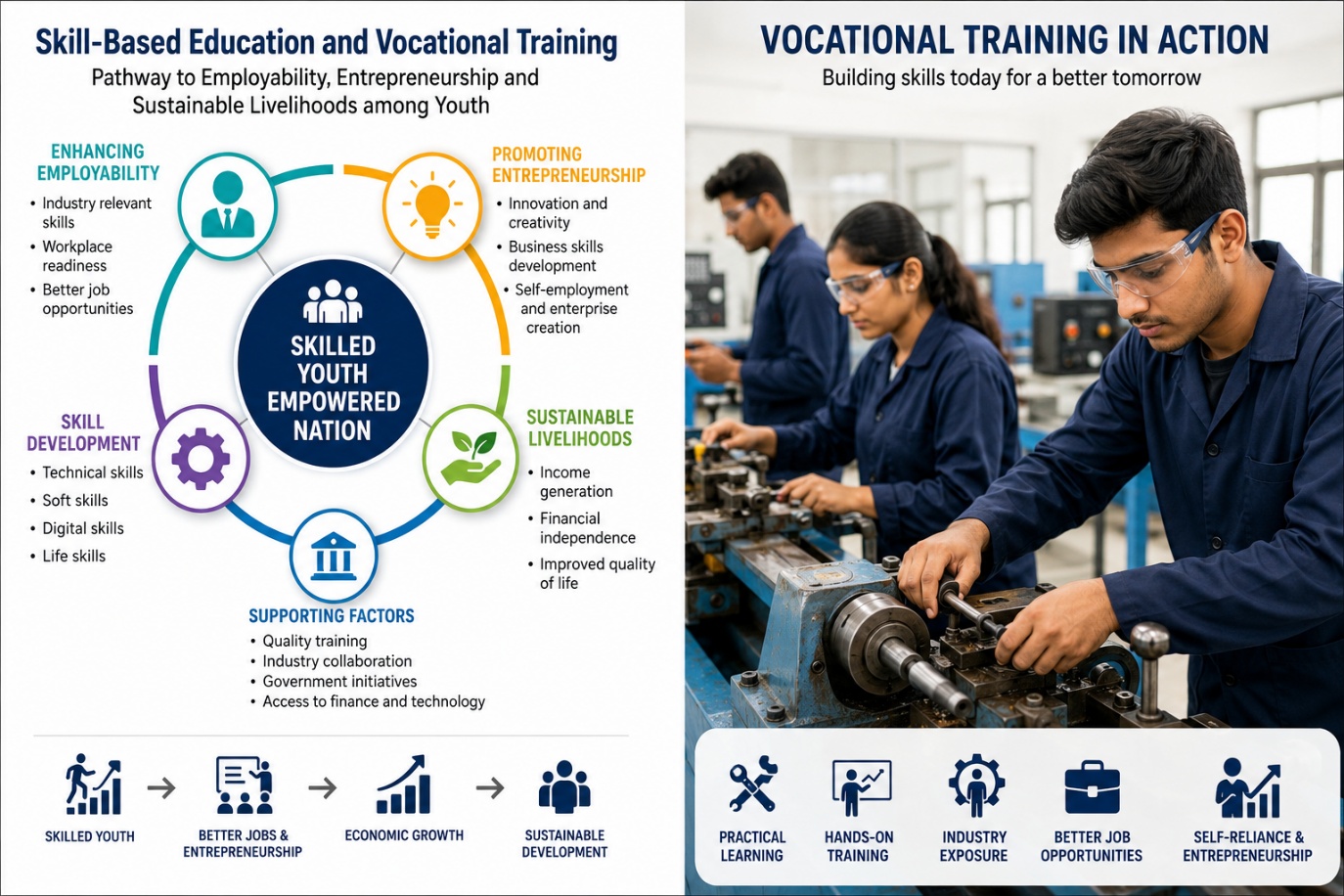
Vocational training refers to organized educational and training programmes designed to develop specific occupational competencies, technical skills, and practical abilities required for particular trades, professions, or industries. Unlike conventional academic education, vocational training emphasizes experiential learning, hands-on practice, workplace exposure, and skill mastery. According to UNESCO (2015), technical and vocational education and training (TVET) encompasses education, training, and skill development processes that prepare individuals for employment, self-employment, and lifelong learning. Thus, vocational training plays a significant role in creating a competent and adaptable workforce.
One of the most important contributions of vocational training is its role in enhancing employability among youth. Employability refers to the ability of individuals to obtain, maintain, and progress in employment through the possession of relevant knowledge, skills, attitudes, and competencies. Modern employers increasingly seek candidates who can perform job-related tasks effectively from the beginning of employment. Vocational training addresses this expectation by providing learners with practical skills directly aligned with occupational requirements. Such skills reduce the gap between education and employment and improve young people's chances of securing meaningful employment.
The issue of youth unemployment has become a major concern across both developed and developing countries. Many young graduates experience unemployment or underemployment despite possessing formal educational qualifications. This situation often arises because educational curricula do not adequately correspond with labour market requirements. Vocational training helps bridge this gap by aligning training programmes with industry needs and equipping learners with marketable skills. The International Labour Organization (ILO, 2020) emphasized that vocational education and training systems play a crucial role in facilitating school-to-work transitions and reducing youth unemployment.
Workforce readiness is another significant outcome of vocational training. Workforce readiness refers to the preparedness of individuals to enter and function effectively within professional environments. It encompasses technical competencies, workplace behaviour, communication skills, teamwork, adaptability, problem-solving abilities, and professional ethics. Vocational training institutions not only impart occupation-specific knowledge but also foster essential employability skills necessary for workplace success. Such comprehensive preparation enables youth to adapt more easily to organizational cultures and job responsibilities.
Technical and occupational competencies constitute the foundation of workforce readiness. Vocational training programmes provide specialized instruction in various sectors, including information technology, healthcare, agriculture, hospitality, construction, automobile engineering, electronics, manufacturing, beauty and wellness, and renewable energy. Through practical exercises, laboratory work, simulations, apprenticeships, and industrial training, learners acquire the technical expertise required for specific occupations. This practical orientation distinguishes vocational training from purely theoretical educational approaches.
Digital transformation has further increased the significance of vocational training. The emergence of Industry 4.0 technologies, automation, artificial intelligence, robotics, cloud computing, and digital platforms has transformed occupational requirements across sectors. Consequently, vocational training programmes increasingly incorporate digital competencies, information technology skills, coding, data analysis, and technological literacy. The World Economic Forum (2020) identified technological proficiency, analytical thinking, and adaptability as among the most important future workforce skills. Vocational training institutions therefore play a critical role in preparing youth for digitally enabled workplaces.
Fostering Entrepreneurial Competencies through Skill Development Initiatives#
Entrepreneurship has become an important source of employment generation, innovation and economic growth in the modern economy. In the present competitive environment, youth cannot depend only on government or private jobs. They also need the ability to create self-employment opportunities and develop small enterprises. Skill development initiatives play a significant role in preparing youth for entrepreneurship by providing technical skills, business knowledge, confidence, creativity and problem-solving abilities.
Entrepreneurial competencies refer to the knowledge, abilities, attitudes and behaviours required to identify opportunities, start a business, manage risks and sustain an enterprise. These competencies include creativity, innovation, decision-making, leadership, financial management, communication, market understanding, digital skills and risk-taking ability. Skill-based education and vocational training help youth develop these competencies through practical training, project work, internships, exposure visits and hands-on learning.
Skill development initiatives encourage youth to become job creators rather than only job seekers. A trained youth can use acquired skills in areas such as tailoring, food processing, beauty and wellness, agriculture, computer services, mobile repair, healthcare support, automobile repair, digital marketing and small manufacturing. These skills can be converted into self-employment ventures, micro-enterprises and local business activities. Thus, vocational training directly supports entrepreneurial development.
Entrepreneurship also requires confidence and self-reliance. Many young people hesitate to start their own work because they lack practical knowledge, market exposure and financial awareness. Skill development programmes reduce this hesitation by providing real-life training and business-related guidance. When youth learn how to produce a product, deliver a service, manage customers and calculate cost and profit, they become more confident in starting income-generating activities.
Financial literacy is an important part of entrepreneurial competency. Youth entrepreneurs must understand budgeting, pricing, saving, credit, profit, loss, investment and loan repayment. Skill development initiatives that include financial education help youth manage their enterprises more effectively. Knowledge of government schemes, bank loans, digital payments and online marketing further strengthens entrepreneurial capacity.
Digital skills have also become essential for modern entrepreneurship. Today, small businesses can use social media, online payment systems, e-commerce platforms and digital marketing to reach customers. Skill development programmes that include digital training enable youth to promote their products, manage online transactions and expand their business opportunities. This is especially useful for rural youth and women who can use digital platforms to connect with wider markets.
Government initiatives such as Skill India Mission, Pradhan Mantri Kaushal Vikas Yojana, National Skill Development Corporation and Start-up India have emphasized the importance of skill development and entrepreneurship promotion among youth. These initiatives aim to provide industry-relevant training, certification, financial support and entrepreneurial guidance. Such programmes can help young people transform skills into livelihood opportunities.
Entrepreneurial competencies are also important for sustainable livelihoods. A skilled youth with entrepreneurial ability can generate regular income, support family needs and contribute to local economic development. Small enterprises can create employment for others and reduce migration from rural to urban areas. Therefore, skill development not only benefits individuals but also strengthens communities and local economies.
However, fostering entrepreneurship through skill development requires proper planning and support. Training alone may not be sufficient unless youth also receive mentoring, market linkage, credit facility, business counselling and follow-up support. Many trained youth fail to start enterprises due to lack of capital, poor market access or limited family support. Therefore, skill development initiatives must be connected with entrepreneurship support systems.
Skill Development for Sustainable Livelihoods and Socio-Economic Empowerment of Youth#
Skill development plays an important role in creating sustainable livelihood opportunities for youth. A sustainable livelihood means a stable, dignified and continuous source of income that helps individuals meet their basic needs, support their families and improve their quality of life. In the present socio-economic environment, youth require not only formal education but also practical, technical, digital and entrepreneurial skills to become economically independent.
Skill-based education and vocational training help youth acquire abilities that are directly linked with employment and income generation. Skills in areas such as agriculture, food processing, tailoring, beauty and wellness, computer applications, mobile repair, healthcare assistance, automobile services, tourism, hospitality and digital marketing can provide youth with opportunities for wage employment as well as self-employment. Such training helps them convert knowledge into productive work.
Skill development is especially important for rural youth, women, school dropouts and economically weaker sections. Many young people from disadvantaged backgrounds face limited access to higher education and formal employment. Vocational training provides them practical opportunities to earn through local trades, small enterprises and community-based occupations. In this way, skill development promotes inclusion and reduces economic dependency.
Socio-economic empowerment means improving the social status, confidence, income level and decision-making ability of individuals. When youth become skilled and financially independent, they gain confidence, respect and participation in family and community life. Skilled youth can support household income, reduce unemployment and contribute to local development. Women’s skill development is particularly important because it promotes self-reliance, dignity and social participation.
Skill development also supports sustainable development by encouraging local employment and reducing migration. When youth receive training suited to local resources and market needs, they can create livelihood opportunities within their own communities. For example, training in agro-based industries, handicrafts, dairy, food processing, repair services and digital services can strengthen local economies and reduce pressure on urban employment markets.
Digital skills have become essential for sustainable livelihoods. Youth with digital knowledge can access online jobs, e-commerce platforms, digital payments, online marketing and remote work opportunities. Digital training helps small entrepreneurs promote products, reach customers and manage financial transactions. Thus, digital skill development expands livelihood opportunities beyond traditional boundaries.
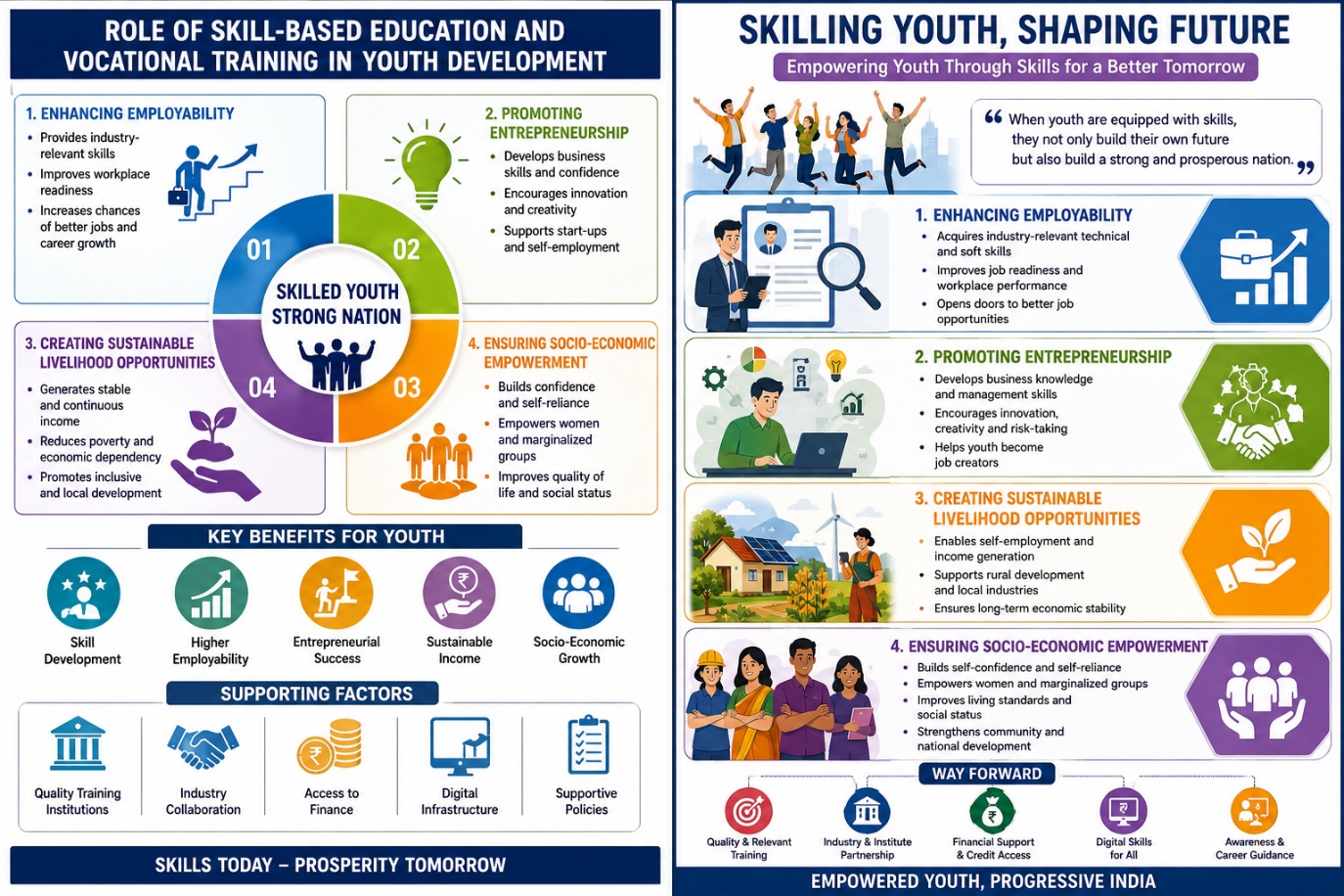
Government schemes and institutional support also play an important role in skill-based empowerment. Initiatives such as Skill India Mission, Pradhan Mantri Kaushal Vikas Yojana, National Skill Development Corporation and Start-up India aim to provide training, certification, employment support and entrepreneurship opportunities to youth. These initiatives can strengthen employability and promote self-employment when linked with market demand and industry needs.
However, sustainable livelihood through skill development requires quality training, practical exposure, certification, financial support, market linkage and continuous guidance. Training programmes should not remain theoretical; they must be connected with real employment opportunities and local economic needs. Follow-up support is also necessary to help trained youth start enterprises or secure suitable jobs.
In conclusion, skill development is a powerful tool for creating sustainable livelihoods and socio-economic empowerment among youth. It improves employability, encourages self-employment, strengthens confidence and reduces unemployment. By linking education with practical skills, entrepreneurship and local opportunities, skill development can help youth become self-reliant, productive and socially empowered.
Conclusion#
Skill-based education and vocational training play a significant role in empowering youth for employment, entrepreneurship and sustainable livelihoods. In the present competitive economy, theoretical education alone is not sufficient; youth also need practical, technical, digital and life skills to become job-ready and self-reliant.
The study highlights that vocational training improves employability by developing industry-relevant skills, workplace readiness and confidence. It also promotes entrepreneurship by helping youth start small businesses, generate income and create employment for others. Skill development is especially important for rural youth, women, school dropouts and economically weaker sections because it provides them with practical opportunities for financial independence.
Thus, skill-based education and vocational training are powerful tools for reducing unemployment, promoting self-employment and strengthening socio-economic development. When supported by quality training, industry linkage, financial assistance and government initiatives, skill development can create confident, productive and economically empowered youth.
Works Cited#
- Drucker, Peter F. Post-Capitalist Society. HarperBusiness, 1993.
- International Labour Organization. Global Employment Trends for Youth 2020. ILO, 2020.
- Kolb, David A. Experiential Learning: Experience as the Source of Learning and Development. Prentice Hall, 1984.
- Ministry of Education, Government of India. National Education Policy 2020. Government of India, 2020.
- Ministry of Skill Development and Entrepreneurship. Skill India Mission: Transforming India through Skill Development. Government of India, 2015.
- National Skill Development Corporation. Annual Report. NSDC, 2020.
- OECD. Skills Outlook 2019: Thriving in a Digital World. OECD Publishing, 2019.
- UNESCO. Recommendation concerning Technical and Vocational Education and Training. UNESCO, 2015.
- UNESCO-UNEVOC. TVET and Skills Development in the Time of COVID-19. UNESCO-UNEVOC, 2021.
- United Nations. Transforming Our World: The 2030 Agenda for Sustainable Development. United Nations, 2015.
- World Bank. World Development Report 2019: The Changing Nature of Work. World Bank, 2019.
- World Economic Forum. The Future of Jobs Report 2020. WEF, 2020.
- Becker, Gary S. Human Capital: A Theoretical and Empirical Analysis. University of Chicago Press, 1993.
- McClelland, David C. “Testing for Competence Rather than for Intelligence.” American Psychologist, vol. 28, no. 1, 1973, pp. 1–14.
- Gibb, Allan A. “Enterprise Culture and Education.” International Small Business Journal, vol. 11, no. 3, 1993, pp. 11–34.
- Nabi, Ghulam, et al. “The Impact of Entrepreneurship Education in Higher Education.” Academy of Management Learning & Education, vol. 16, no. 2, 2017, pp. 277–299.
- Dees, J. Gregory. “The Meaning of Social Entrepreneurship.” Stanford University, 1998.
- Schumpeter, Joseph A. The Theory of Economic Development. Harvard UP, 1934.
- Sen, Amartya. Development as Freedom. Oxford UP, 1999.
- National Skill Development Agency. National Skill Qualification Framework. Government of India, 2013.
"A Multidisciplinary Investigation of Gender Equality, Women's Empowerment, and Socio-Economic Development in