Abstract
Self-efficacy, career aspirations, and employability skills are fundamental determinants of students’ academic success, career readiness, and long-term professional development in the rapidly evolving global labour market. Higher education institutions are increasingly expected to equip students not only with disciplinary knowledge but also with the confidence, competencies, and practical skills required to meet the demands of modern workplaces. The present study examines the relationship between self-efficacy, career aspirations, and employability skills among higher education students. It explores how students’ beliefs in their capabilities influence career planning, goal setting, motivation, decision-making, and professional achievement. The study further investigates the importance of employability skills such as communication, teamwork, leadership, problem-solving, digital literacy, critical thinking, adaptability, creativity, and emotional intelligence in enhancing students’ career readiness and employment opportunities. In addition, it identifies major challenges affecting students’ career development, including skill gaps, limited industry exposure, inadequate career guidance, technological changes, and increasing competition in the employment market. The study emphasizes the role of universities, educators, employers, policymakers, and families in creating supportive learning environments that strengthen students’ confidence, aspirations, and professional competencies. It concludes that integrating career development programmes, experiential learning, internships, mentorship, entrepreneurship education, and skill-based training into higher education curricula can significantly improve employability and lifelong career success. Strengthening self-efficacy and employability skills ultimately prepares graduates to become adaptable, innovative, confident, and socially responsible professionals capable of contributing effectively to national and global economic development.
- Self-Efficacy
- Career Aspirations
- Employability Skills
- Higher Education
- Career Readiness
- Professional Development
- Communication Skills
- Leadership
- Critical Thinking
- Digital Literacy
Introduction#
The contemporary employment landscape has undergone remarkable transformation due to globalization, technological advancement, digitalization, automation, and the emergence of knowledge-based economies. Employers no longer evaluate graduates solely on the basis of academic qualifications but increasingly seek individuals who possess confidence, adaptability, practical competencies, communication abilities, leadership qualities, problem-solving skills, emotional intelligence, and lifelong learning attitudes. Consequently, higher education institutions are expected to prepare students not only for academic excellence but also for successful professional careers by developing the knowledge, skills, attitudes, and behaviours required in dynamic workplaces. Among the various psychological and educational factors influencing career success, self-efficacy has emerged as one of the most significant determinants of students' motivation, academic achievement, career planning, and professional performance. Self-efficacy refers to an individual's belief in his or her capability to organize and execute actions necessary to accomplish specific goals and overcome challenges. Students with higher self-efficacy generally demonstrate greater confidence in learning new concepts, solving complex problems, participating in academic activities, adapting to changing environments, and pursuing ambitious career goals. They are more likely to persist despite obstacles, maintain positive attitudes toward learning, actively seek opportunities for professional growth, and exhibit resilience when facing academic or career-related setbacks. In contrast, students with low self-efficacy often experience self-doubt, fear of failure, reduced motivation, academic anxiety, and hesitation in pursuing challenging career opportunities, which may limit their professional development and employability.
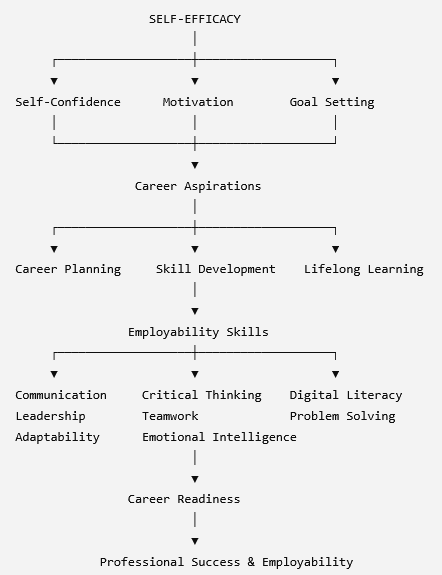
Figure: Conceptual Background
Career aspirations represent another important dimension of students' educational and professional development. Career aspirations refer to the professional goals, ambitions, and occupational achievements that individuals hope to attain throughout their careers. These aspirations are shaped by personal interests, academic experiences, family expectations, socio-economic background, cultural influences, peer interactions, educational opportunities, labour market conditions, and perceived career prospects. Strong career aspirations motivate students to invest greater effort in academic learning, skill development, internship participation, networking, and career planning activities. However, achieving these aspirations requires the development of employability skills that enable graduates to perform effectively in professional environments. Employability skills include communication, teamwork, leadership, creativity, critical thinking, digital literacy, adaptability, decision-making, conflict resolution, ethical behaviour, emotional intelligence, and entrepreneurial competencies. These transferable skills complement academic knowledge and significantly enhance graduates' ability to secure employment, adapt to organizational changes, and achieve long-term career success. Despite increasing awareness of employability, many graduates continue to experience skill gaps due to limited practical exposure, insufficient industry collaboration, inadequate career guidance, and rapidly evolving workplace requirements. Therefore, understanding the relationship between self-efficacy, career aspirations, and employability skills has become essential for educators, policymakers, employers, and researchers seeking to improve higher education outcomes. Universities must integrate experiential learning, internships, career counselling, mentorship programmes, industry partnerships, entrepreneurship education, and competency-based training into academic curricula to prepare graduates for successful transitions from education to employment. Strengthening students' confidence, career motivation, and professional competencies not only improves individual employability but also contributes to national economic growth, innovation, workforce productivity, and sustainable social development in the increasingly competitive global economy.
2.Relationship between Self-Efficacy and Career Aspirations among Higher Education Students
Self-efficacy is a fundamental psychological construct that significantly influences students’ academic achievement, career aspirations, motivation, and professional development. It refers to an individual's belief in his or her ability to successfully perform specific tasks, overcome challenges, and achieve desired goals. Among higher education students, self-efficacy determines how confidently they approach academic responsibilities, participate in learning experiences, solve complex problems, and prepare for future careers. Students with strong self-efficacy demonstrate higher motivation, greater persistence, better decision-making abilities, and stronger commitment toward achieving their professional aspirations. They actively seek opportunities for internships, research activities, leadership roles, professional networking, and skill development because they believe in their ability to succeed even when confronted with obstacles or failures. High self-efficacy also encourages students to set ambitious career goals and pursue competitive professions, entrepreneurial ventures, postgraduate education, or specialized training programmes. Conversely, students with low self-efficacy often underestimate their abilities, avoid challenging tasks, experience fear of failure, hesitate to participate in career development activities, and limit their occupational ambitions. These individuals may experience academic anxiety, low confidence during interviews, ineffective career planning, and reduced willingness to explore new employment opportunities. Career aspirations are closely associated with self-efficacy because individuals who possess confidence in their abilities are more likely to establish clear career objectives and invest continuous effort toward achieving them. Family support, positive academic experiences, mentoring, role models, peer encouragement, constructive feedback, and successful learning experiences further strengthen students’ self-efficacy and inspire higher career aspirations. Educational institutions play an essential role in nurturing self-efficacy by providing supportive learning environments, experiential education, industry interaction, career counselling, internship opportunities, and competency-based learning. Through practical exposure, students gain confidence in applying theoretical knowledge to real-world situations, thereby strengthening both self-belief and career motivation. Self-efficacy also promotes resilience, enabling students to recover from setbacks, adapt to changing career environments, and continuously improve their professional competencies. In today's highly competitive labour market, where technological changes continuously reshape employment opportunities, students require confidence not only in their academic knowledge but also in their capacity to acquire new skills and adapt to emerging workplace demands. Therefore, strengthening self-efficacy during higher education contributes significantly to students’ career aspirations, lifelong learning attitudes, employability, and long-term professional success.
Role of Employability Skills in Enhancing Career Readiness and Professional Success#
Employability skills have become one of the most essential determinants of career readiness and long-term professional success among higher education students. In today's dynamic and technology-driven labour market, employers seek graduates who possess not only strong academic knowledge but also a wide range of transferable skills that enable them to perform effectively in diverse professional environments. Employability skills refer to the combination of technical competencies, interpersonal abilities, cognitive skills, professional attitudes, and personal attributes that enhance an individual's capacity to obtain, maintain, and progress in employment. These skills include effective communication, teamwork, leadership, critical thinking, problem-solving, adaptability, digital literacy, creativity, emotional intelligence, time management, ethical decision-making, and lifelong learning. Students who develop these competencies during their higher education are better prepared to meet workplace expectations, adapt to organizational changes, and contribute meaningfully to institutional growth and innovation. Communication skills enable graduates to express ideas clearly, interact confidently with colleagues and clients, prepare professional reports, participate in presentations, and resolve workplace conflicts effectively. Teamwork and collaboration foster cooperation, mutual respect, and collective problem-solving, which are essential in multidisciplinary work environments. Leadership skills empower students to motivate others, manage responsibilities, make informed decisions, and coordinate organizational activities efficiently. Critical thinking and analytical reasoning enable graduates to evaluate information objectively, solve complex problems, identify innovative solutions, and make evidence-based decisions in professional settings. Digital literacy has become indispensable due to the increasing integration of information technology, artificial intelligence, cloud computing, and digital communication tools across industries. Students proficient in digital technologies are more competitive in the labour market because they can efficiently utilize software applications, online collaboration platforms, data analysis tools, and emerging technologies. Adaptability and flexibility have gained greater importance as organizations continuously respond to globalization, technological innovation, and changing business environments. Graduates who demonstrate resilience, willingness to learn, and openness to change are better equipped to manage workplace transitions and acquire new competencies throughout their careers. Emotional intelligence also plays a crucial role by enabling individuals to understand and regulate emotions, build positive interpersonal relationships, manage workplace stress, and demonstrate empathy toward colleagues and clients. Strong emotional intelligence contributes significantly to leadership effectiveness, conflict resolution, employee satisfaction, and organizational productivity. Time management and organizational skills allow students to prioritize tasks, meet deadlines, balance multiple responsibilities, and maintain high levels of productivity in demanding work environments. Furthermore, ethical behaviour, integrity, professionalism, and social responsibility enhance organizational trust and contribute to sustainable business practices. Higher education institutions play a central role in developing employability skills by integrating competency-based education, project-based learning, internships, industrial training, field visits, case studies, simulations, entrepreneurship education, research activities, and community engagement into academic programmes. Industry-academia collaboration provides valuable opportunities for students to gain practical experience, understand workplace expectations, and apply theoretical knowledge to real-world situations. Career development centres, placement cells, mentoring programmes, professional workshops, certification courses, and career counselling services further strengthen students' employability by enhancing career awareness and professional preparedness. Despite these initiatives, many graduates continue to experience employability challenges due to insufficient practical exposure, inadequate communication abilities, limited technological competence, and gaps between academic curricula and industry requirements. Therefore, continuous curriculum revision based on labour market needs, active employer participation in curriculum design, and lifelong learning opportunities are essential for ensuring graduate employability. Ultimately, employability skills complement academic qualifications by enabling graduates to perform effectively, adapt successfully, and achieve sustainable career growth in an increasingly competitive global economy. Strengthening these competencies not only benefits individual career development but also enhances workforce productivity, organizational competitiveness, innovation, and national economic development.
Strategies for Strengthening Self-Efficacy, Career Aspirations, and Employability Skills in Higher Education#
Developing self-efficacy, career aspirations, and employability skills among higher education students requires a comprehensive educational approach that combines academic excellence with practical learning, psychological development, career guidance, and industry engagement. One of the most effective strategies is the integration of competency-based education into university curricula. Rather than focusing exclusively on theoretical knowledge, higher education institutions should emphasize practical skill development through project-based learning, experiential education, laboratory activities, internships, industrial visits, simulations, fieldwork, and problem-solving exercises. These learning experiences increase students' confidence by allowing them to apply classroom knowledge to real-world situations while strengthening their professional competencies. Career counselling and guidance services also play a vital role in helping students identify their strengths, interests, career goals, and suitable employment opportunities. Regular career counselling sessions, aptitude assessments, personality development programmes, and individual mentoring assist students in making informed career decisions and developing realistic career aspirations. Mentorship programmes involving experienced faculty members, industry professionals, successful alumni, and entrepreneurs further motivate students by providing career advice, professional networking opportunities, and practical insights into workplace expectations.
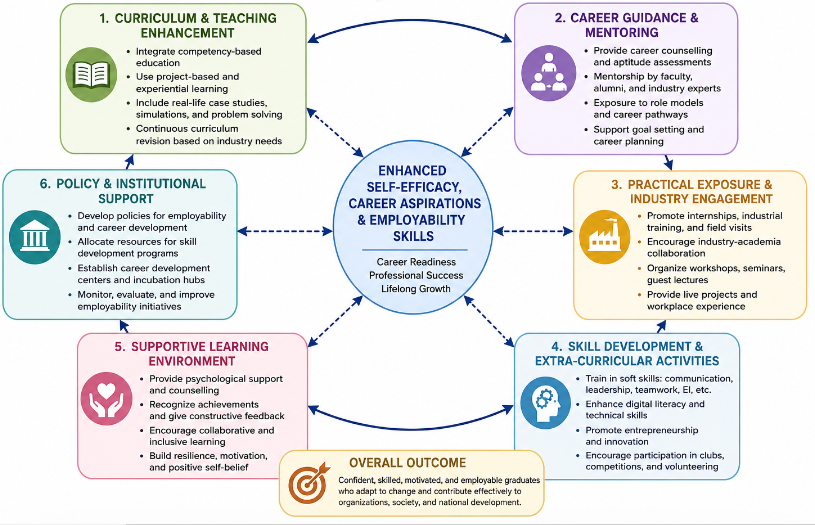
Figure: Strategies for Strengthening Self-Efficacy, Career Aspirations, and Employability Skills in Higher Education
Internship programmes are equally important because they expose students to organizational environments, enhance technical competencies, improve communication skills, and strengthen self-confidence through hands-on experience. Industry-academia partnerships should therefore be expanded to ensure that students receive practical training aligned with evolving labour market requirements. Universities should also organize workshops, seminars, guest lectures, career fairs, placement drives, and professional certification programmes to familiarize students with emerging career opportunities and current industry trends. Soft skill development should become an integral component of higher education curricula, with dedicated training in communication, teamwork, leadership, emotional intelligence, critical thinking, negotiation, presentation skills, conflict resolution, and time management. Since digital transformation has significantly altered workplace expectations, institutions must strengthen students' digital competencies by providing training in information technology, artificial intelligence, data analytics, cybersecurity, cloud computing, digital communication, and emerging technologies relevant to different professions. Entrepreneurship education represents another effective strategy for enhancing self-efficacy and career aspirations by encouraging innovation, creativity, opportunity recognition, business planning, financial literacy, and risk management. Students should be encouraged to participate in startup incubation centres, innovation laboratories, entrepreneurship competitions, and business mentoring programmes that develop entrepreneurial confidence and self-employment capabilities. Psychological well-being also influences self-efficacy and employability; therefore, universities should establish counselling centres, mental health awareness programmes, stress management workshops, and resilience-building initiatives that promote emotional stability and positive self-belief. Constructive feedback from educators, recognition of student achievements, collaborative learning environments, and opportunities for leadership roles further strengthen students' confidence and motivation. Governments and policymakers should support higher education institutions through funding, policy reforms, industry collaboration initiatives, skill development programmes, and national employability frameworks that encourage competency-based education. Continuous curriculum revision based on employer expectations, technological advancements, and future workforce demands is essential to maintain educational relevance. Lifelong learning opportunities, online certification programmes, digital learning platforms, and professional development courses should also be promoted to enable graduates to continuously update their knowledge and skills throughout their careers. Ultimately, strengthening self-efficacy, career aspirations, and employability skills requires coordinated efforts among educational institutions, employers, families, governments, and students themselves. Such collaborative approaches produce confident, adaptable, innovative, and professionally competent graduates capable of achieving sustainable career success while contributing effectively to economic development, organizational productivity, and social progress.
Conclusion#
Self-efficacy, career aspirations, and employability skills constitute three interconnected pillars of successful higher education and professional development. The present study demonstrates that students' confidence in their abilities significantly influences their academic performance, career planning, motivation, resilience, and willingness to pursue challenging professional opportunities. Students possessing high self-efficacy are more likely to establish ambitious career goals, actively participate in academic and extracurricular activities, develop leadership qualities, and persist in overcoming academic and professional challenges. At the same time, well-defined career aspirations encourage students to invest greater effort in learning, skill development, internships, networking, and lifelong professional growth. However, achieving career success in today's rapidly changing labour market requires more than academic excellence alone. Employers increasingly seek graduates equipped with employability skills such as effective communication, teamwork, leadership, critical thinking, creativity, emotional intelligence, adaptability, digital literacy, problem-solving, and ethical professionalism. These competencies enable graduates to transition successfully from higher education to employment while adapting to technological innovations, organizational changes, and global workforce demands. The study further emphasizes that higher education institutions have a critical responsibility to bridge the gap between academic learning and industry expectations by integrating competency-based education, experiential learning, internships, industry collaboration, entrepreneurship education, career counselling, mentorship, and soft skill development into academic programmes. Supportive learning environments that encourage innovation, collaborative learning, constructive feedback, and psychological well-being further strengthen students' confidence and professional preparedness. Governments, employers, policymakers, and educational institutions must work collaboratively to design policies and programmes that enhance graduate employability through curriculum modernization, digital skill development, industry partnerships, and continuous professional learning opportunities. Families and mentors also contribute significantly by providing emotional support, career guidance, and motivation throughout students' educational journeys. As technological advancement, globalization, and automation continue to reshape employment opportunities, graduates must develop lifelong learning attitudes that enable them to continuously acquire new competencies and remain competitive in evolving labour markets. The study concludes that strengthening self-efficacy, career aspirations, and employability skills creates confident, adaptable, innovative, and socially responsible graduates capable of contributing effectively to organizational success, national economic growth, and sustainable development. Continuous investment in quality higher education, career development initiatives, industry engagement, and holistic student development will therefore remain essential for preparing future professionals to succeed in an increasingly competitive and knowledge-driven global economy.
---
Works Cited#
- Bandura, A. (1997). *Self-Efficacy: The Exercise of Control*. W. H. Freeman.
- Bandura, A. (1986). *Social Foundations of Thought and Action: A Social Cognitive Theory*. Prentice-Hall.
- Yorke, M. (2006). *Employability in Higher Education: What It Is and What It Is Not*. Higher Education Academy.
- Dacre Pool, L., & Sewell, P. (2007). The key to employability. *Education + Training, 49*(4), 277–289.
- Fugate, M., Kinicki, A. J., & Ashforth, B. E. (2004). Employability: A psycho-social construct. *Journal of Vocational Behavior, 65*(1), 14–38.
- Jackson, D. (2015). Employability skill development in work-integrated learning. *Studies in Higher Education, 40*(2), 350–367.
- Tomlinson, M. (2017). Forms of graduate capital and employability. *Education + Training, 59*(4), 338–352.
- Yorke, M., & Knight, P. T. (2006). *Embedding Employability into the Curriculum*. Higher Education Academy.
- Super, D. E. (1990). A life-span, life-space approach to career development. In *Career Choice and Development*.
- Lent, R. W., Brown, S. D., & Hackett, G. (1994). Toward a unifying social cognitive theory of career and academic interest. *Journal of Vocational Behavior, 45*(1), 79–122.
- Savickas, M. L. (2013). *Career Construction Theory and Practice*. Springer.
- Nauta, M. M. (2007). Career interests, self-efficacy, and personality. *Journal of Career Assessment, 15*(2), 162–180.
- Robles, M. M. (2012). Executive perceptions of the top soft skills needed. *Business Communication Quarterly, 75*(4), 453–465.
- World Economic Forum. (2023). *The Future of Jobs Report 2023*.
- UNESCO. (2023). *Global Education Monitoring Report 2023*.
- OECD. (2023). *Education at a Glance 2023*. OECD Publishing.
- World Bank. (2022). *World Development Report 2022*.
- National Association of Colleges and Employers. (2024). *Career Readiness Competencies*.
- Harvey, L. (2005). Embedding and integrating employability. *New Directions for Institutional Research, 128*, 13–28.
- Knight, P. T., & Yorke, M. (2004). *Learning, Curriculum and Employability in Higher Education*. Routledge.