Abstract
The present study aims to explore how students’ tendency to delay academic tasks and their ability to regulate learning influence their academic achievement. Academic procrastination refers to the unnecessary postponement of study-related activities such as completing homework, preparing for examinations, submitting assignments, and revising lessons. Self-regulated learning refers to students’ ability to plan, monitor, control, and evaluate their own learning process. Academic performance reflects the educational achievement of students, usually measured through marks, grades, or examination scores. The study focuses on secondary school students because this stage is important for academic growth, career preparation, habit formation, and personality development. Students at this level often face academic pressure, examination stress, digital distractions, lack of motivation, and time-management difficulties. These factors may increase academic procrastination and negatively affect academic performance. On the other hand, students with strong self-regulated learning skills are generally better able to set goals, manage time, use effective study strategies, control distractions, and maintain motivation. The study may adopt a descriptive and correlational research design. Data may be collected from secondary school students through standardized scales related to academic procrastination and self-regulated learning, along with academic performance records. The study is expected to find a negative relationship between academic procrastination and academic performance, while self-regulated learning is expected to show a positive relationship with academic performance. It may also reveal that self-regulated learning helps reduce procrastination and improves students’ achievement.
- Academic Procrastination
- Self-Regulated Learning
- Academic Performance
- Secondary School Students
- Study Habits
- Time Management
- Learning Motivation
- Goal Setting
- Examination Achievement
- Student Behaviour
Introduction#
Education plays an important role in the intellectual, emotional, social, and moral development of students. At the secondary school level, students enter an important stage of academic and personal growth. This stage prepares them for higher education, career selection, competitive examinations, and future responsibilities. Therefore, the academic performance of secondary school students is an important area of study for teachers, parents, counsellors, and educational researchers.
Academic performance refers to the achievement of students in school subjects, examinations, assignments, class tests, and overall learning activities. It is commonly measured through marks, grades, percentage, or academic records. Good academic performance is not only the result of intelligence; it is also influenced by study habits, motivation, emotional control, time management, classroom participation, family support, school environment, and learning strategies.
In the present educational environment, many students face academic pressure, examination fear, peer competition, social media distraction, lack of concentration, and poor planning. Due to these factors, students may delay their academic work. This habit is known as academic procrastination. Academic procrastination means postponing study-related tasks even when students know that delay may create problems. It includes delaying homework, avoiding revision, preparing late for examinations, submitting assignments after the deadline, and wasting time on non-academic activities.
Academic procrastination is a common problem among secondary school students. It may occur due to laziness, fear of failure, lack of interest, low confidence, poor time management, perfectionism, anxiety, or excessive use of mobile phones and digital media. When students repeatedly delay their academic tasks, they may experience stress, guilt, incomplete preparation, poor understanding, and low achievement. Thus, academic procrastination may negatively affect academic performance.
Self-regulated learning is an important factor that helps students control their learning process. It refers to the ability of students to plan their studies, set goals, manage time, monitor progress, use suitable learning strategies, remain motivated, and evaluate their own performance. A self-regulated learner does not depend completely on teachers or parents. Such a student takes responsibility for learning and works in an organized manner.
Students with strong self-regulated learning skills usually prepare study schedules, revise regularly, complete assignments on time, ask questions, control distractions, and check their own mistakes. They are able to understand their strengths and weaknesses and improve their learning accordingly. Self-regulated learning improves confidence, discipline, motivation, and academic achievement.
The relationship between academic procrastination and self-regulated learning is very important. Students who lack self-regulation often fail to manage time and delay academic activities. They may study only before examinations and may not complete work regularly. On the other hand, students with better self-regulation are less likely to procrastinate because they can set goals and follow planned study habits. Therefore, self-regulated learning may reduce academic procrastination and support better academic performance.
Academic performance is influenced by both academic procrastination and self-regulated learning. High procrastination may lead to low performance, while high self-regulated learning may lead to better academic outcomes. Secondary school students who manage time properly and study regularly are more likely to perform well in examinations. Students who delay academic work may face last-minute pressure and poor results.
The present study titled “Examining the Relationship between Academic Procrastination, Self-Regulated Learning, and Academic Performance among Secondary School Students” is significant because it focuses on three important aspects of student learning. It attempts to understand how delaying academic tasks and regulating learning behaviour are related to students’ academic achievement. The findings of the study may help teachers identify students who need support in time management, motivation, study planning, and self-discipline.
This study may also be useful for parents and school counsellors. Parents can help students create a suitable study environment at home, reduce distractions, and encourage regular study habits. Counsellors can organize guidance programmes on goal setting, stress management, examination preparation, and overcoming procrastination. Teachers can use classroom strategies that promote active learning, timely feedback, and responsibility among students.
Thus, studying academic procrastination, self-regulated learning, and academic performance is necessary for improving the educational growth of secondary school students. By understanding these relationships, schools can develop better academic support systems and help students become disciplined, motivated, and successful learners.
Academic Procrastination among Secondary School Students#
Academic procrastination means delaying school-related work without a valid reason. It includes postponing homework, revision, assignments, project work, examination preparation, and classroom tasks. At the secondary school level, students often face many academic and personal pressures. They have to manage different subjects, tests, homework, tuition, co-curricular activities, and expectations from parents and teachers. Due to this pressure, some students avoid difficult tasks and delay their studies.
Academic procrastination may occur because of poor time management, lack of interest, fear of failure, low confidence, laziness, examination anxiety, perfectionism, and excessive use of mobile phones or social media. Some students delay work because they feel the task is difficult. Some wait for the “right mood” to study. Others believe they can complete everything at the last moment. However, this habit usually creates stress and poor preparation.
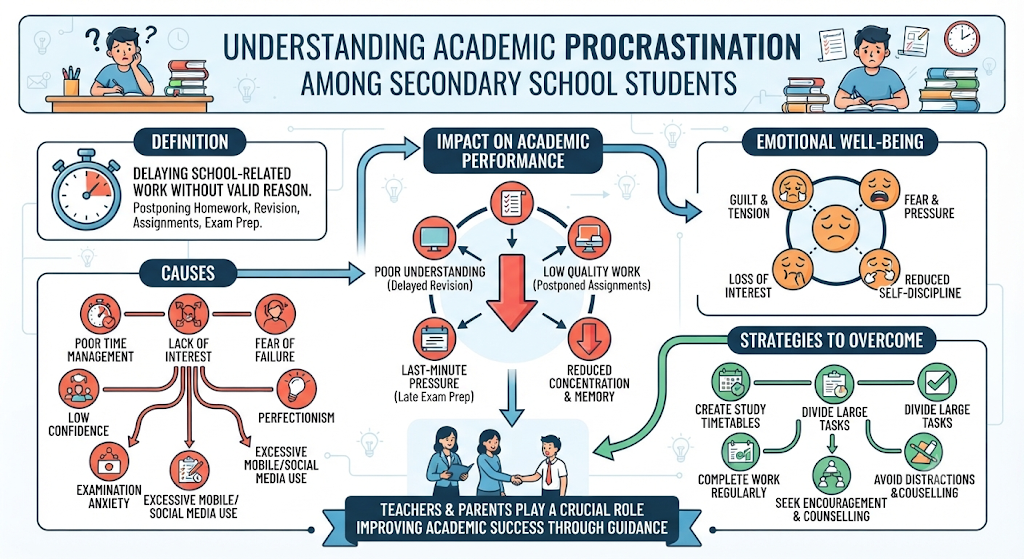
Among secondary school students, procrastination can become a serious academic problem. When students delay revision, they may not understand lessons properly. When they postpone assignments, the quality of work becomes poor. When they prepare late for examinations, they may feel nervous and confused. This affects their concentration, memory, confidence, and academic performance.
Academic procrastination also affects emotional well-being. Students who delay work often feel guilt, tension, fear, and pressure. They may lose interest in studies and develop a negative attitude toward learning. Repeated delay may become a habit and may reduce self-discipline. Therefore, academic procrastination should not be treated as simple laziness; it is connected with motivation, behaviour, emotions, and learning habits.
Teachers and parents play an important role in reducing academic procrastination. Students should be guided to prepare study timetables, divide large tasks into small parts, complete work regularly, avoid distractions, and revise daily. Encouragement, counselling, timely feedback, and positive reinforcement can help students overcome delay habits. Thus, academic procrastination is an important factor that must be studied to improve academic success among secondary school students.
Self-Regulated Learning and Student Development#
Self-regulated learning refers to the ability of students to control and manage their own learning process. It means that students plan their studies, set learning goals, manage time, monitor progress, use suitable study methods, and evaluate their performance. A self-regulated learner takes responsibility for learning instead of depending completely on teachers, parents, or tuition.
At the secondary school stage, self-regulated learning is very important because students begin to face higher academic demands. They have to prepare for board examinations, career decisions, competitive learning, and personal development. Students who are self-regulated are usually more disciplined, organized, motivated, and confident. They know what to study, when to study, and how to improve.
Self-regulated learning includes many important skills. Goal setting helps students decide what they want to achieve. Time management helps them complete academic work on time. Self-monitoring helps them check whether they are understanding the lesson. Self-evaluation helps them identify mistakes and improve performance. Motivation helps them continue studying even when the task is difficult.
Students with good self-regulated learning skills usually revise regularly, complete homework on time, prepare notes, ask questions, avoid unnecessary distractions, and remain focused during study. They are able to balance schoolwork and personal activities. They also use better learning strategies such as summarizing, underlining, practicing questions, making charts, and revising important points.
Self-regulated learning contributes to overall student development. It improves academic achievement, confidence, discipline, problem-solving ability, and independent thinking. It also helps students reduce stress because they do not depend on last-minute preparation. When students follow a planned learning process, they feel more prepared and secure.
Schools can promote self-regulated learning by encouraging active learning, project-based tasks, regular assessment, feedback, study planning, and reflective learning. Teachers should guide students to set realistic goals and monitor their progress. Parents should provide a supportive home environment and encourage regular study habits. Thus, self-regulated learning is an essential factor in improving academic performance and reducing academic difficulties among secondary school students.
Academic Performance and Learning Outcomes#
Academic performance refers to the achievement of students in school education. It is commonly measured through marks, grades, test scores, examination results, assignments, and classroom performance. Academic performance reflects how well students understand, remember, apply, and present what they have learned. It is one of the major indicators of educational progress.
At the secondary school level, academic performance becomes highly important because it influences future educational opportunities, subject selection, career planning, confidence, and social recognition. Good academic performance helps students develop self-confidence and motivation. It also gives satisfaction to parents and teachers. Poor academic performance, on the other hand, may create stress, fear, disappointment, and low self-esteem.
Academic performance is not determined by intelligence alone. Many factors influence it, such as study habits, motivation, classroom teaching, family support, school environment, peer influence, emotional stability, time management, health, and learning strategies. Two important factors related to academic performance are academic procrastination and self-regulated learning.
Students who frequently procrastinate may show lower academic performance because they do not prepare regularly. They may complete assignments in a hurry, revise lessons late, and face difficulty during examinations. This reduces understanding and increases pressure. On the other hand, students who practice self-regulated learning usually perform better because they plan their studies, revise regularly, and monitor their progress.
Academic performance also reflects the effectiveness of the teaching-learning process. If many students perform poorly, it may indicate problems in teaching methods, learning environment, assessment pattern, or student support systems. Therefore, academic performance should be studied not only as marks but also as a reflection of learning quality.
Improving academic performance requires a balanced approach. Students need guidance in time management, motivation, study skills, emotional control, and examination preparation. Teachers should provide clear explanations, regular feedback, remedial support, and encouraging classroom practices. Parents should avoid excessive pressure and instead support discipline, confidence, and healthy learning habits. Thus, academic performance is an important outcome of student learning. It is closely related to students’ behaviour, self-control, motivation, and study planning. Understanding the factors affecting academic performance can help schools design better academic support programmes for secondary school students.
Relationship between Academic Procrastination, Self-Regulated Learning, and Academic Performance#
Academic procrastination, self-regulated learning, and academic performance are closely related to one another. Academic procrastination represents delay in learning tasks, self-regulated learning represents control over learning behaviour, and academic performance represents the outcome of learning. These three variables together explain important aspects of students’ academic life.
Academic procrastination usually has a negative relationship with academic performance. Students who delay their studies often face incomplete preparation, poor understanding, examination stress, and low confidence. They may not revise lessons properly and may make more mistakes in tests. As a result, their marks and grades may decrease. Regular delay also weakens discipline and study habits.
Self-regulated learning generally has a positive relationship with academic performance. Students who can plan, monitor, and evaluate their learning are more likely to achieve better academic results. They prepare regularly, manage time effectively, complete assignments on schedule, and use suitable learning strategies. Such students are more confident and better prepared for examinations.
Self-regulated learning also has a negative relationship with academic procrastination. Students with strong self-regulation are less likely to postpone academic tasks. They set goals, follow timetables, control distractions, and complete work step by step. In contrast, students with weak self-regulation may delay work because they lack planning, motivation, and self-control.
The relationship among these variables is important for secondary school students because this stage forms the foundation for higher education and future careers. If procrastination becomes a habit, it may continue into college and professional life. If self-regulated learning is developed early, students can become independent, disciplined, and successful learners.
Teachers, parents, and counsellors can use this understanding to support students. Students with high procrastination should be helped through counselling, study planning, short-term goals, regular monitoring, and motivation. Students should be trained in self-regulated learning skills such as goal setting, timetable preparation, self-assessment, revision planning, and distraction control.
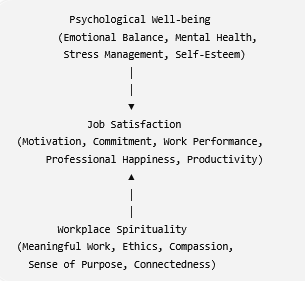
Figure: Relationship between Academic Procrastination, Self-Regulated Learning, and Academic Performance
Thus, the relationship between academic procrastination, self-regulated learning, and academic performance is highly significant. Reducing procrastination and improving self-regulated learning can lead to better academic outcomes. This study can help schools understand student learning behaviour and design effective strategies for academic improvement.
Conclusion#
The study concludes that academic procrastination, self-regulated learning, and academic performance are closely related among secondary school students. Academic procrastination negatively affects students’ learning because it leads to delay in homework, revision, assignment completion, and examination preparation. Students who frequently postpone academic tasks often experience stress, poor time management, incomplete preparation, and lower academic achievement.
Self-regulated learning plays a positive role in improving academic performance. Students who set learning goals, prepare study schedules, monitor their progress, control distractions, and evaluate their own learning generally perform better in school examinations. Such students are more disciplined, confident, motivated, and responsible toward their studies.
The study also shows that self-regulated learning can reduce academic procrastination. When students develop planning, time management, self-motivation, and self-evaluation skills, they are less likely to delay academic work. Therefore, teachers, parents, and school counsellors should help students develop regular study habits, goal-setting skills, emotional control, and effective learning strategies.
In conclusion, reducing academic procrastination and strengthening self-regulated learning can improve academic performance among secondary school students. Schools should organize guidance programmes, counselling sessions, study-skill workshops, and motivational activities to support students’ academic growth.
Works Cited#
- Bandura, Albert. Self-Efficacy: The Exercise of Control. W. H. Freeman, 1997.
- Boekaerts, Monique, Paul R. Pintrich, and Moshe Zeidner, editors. Handbook of Self-Regulation. Academic Press, 2000.
- Corno, Lyn. “The Metacognitive Control Components of Self-Regulated Learning.” Contemporary Educational Psychology, vol. 11, no. 4, 1986, pp. 333–346.
- Ferrari, Joseph R., Judith L. Johnson, and William G. McCown. Procrastination and Task Avoidance: Theory, Research, and Treatment. Plenum Press, 1995.
- Klassen, Robert M., Lindsey L. Krawchuk, and Sukaina Rajani. “Academic Procrastination of Undergraduates: Low Self-Efficacy to Self-Regulate Predicts Higher Levels of Procrastination.” Contemporary Educational Psychology, vol. 33, no. 4, 2008, pp. 915–931.
- Lay, Clarry H. “At Last, My Research Article on Procrastination.” Journal of Research in Personality, vol. 20, no. 4, 1986, pp. 474–495.
- McClelland, David C. Human Motivation. Cambridge University Press, 1987.
- Pajares, Frank. “Self-Efficacy Beliefs in Academic Settings.” Review of Educational Research, vol. 66, no. 4, 1996, pp. 543–578.
- Pintrich, Paul R. “The Role of Goal Orientation in Self-Regulated Learning.” Handbook of Self-Regulation, edited by Monique Boekaerts et al., Academic Press, 2000, pp. 451–502.
- Pintrich, Paul R., and Elisabeth V. De Groot. “Motivational and Self-Regulated Learning Components of Classroom Academic Performance.” Journal of Educational Psychology, vol. 82, no. 1, 1990, pp. 33–40.
- Schouwenburg, Henri C., et al., editors. Counseling the Procrastinator in Academic Settings. American Psychological Association, 2004.
- Schunk, Dale H. “Self-Efficacy and Academic Motivation.” Educational Psychologist, vol. 26, no. 3–4, 1991, pp. 207–231.
- Schunk, Dale H., and Barry J. Zimmerman, editors. Self-Regulated Learning: From Teaching to Self-Reflective Practice. Guilford Press, 1998.
- Senécal, Caroline, Richard Koestner, and Robert J. Vallerand. “Self-Regulation and Academic Procrastination.” The Journal of Social Psychology, vol. 135, no. 5, 1995, pp. 607–619.
- Steel, Piers. “The Nature of Procrastination: A Meta-Analytic and Theoretical Review of Quintessential Self-Regulatory Failure.” Psychological Bulletin, vol. 133, no. 1, 2007, pp. 65–94.
- Wolters, Christopher A. “Understanding Procrastination from a Self-Regulated Learning Perspective.” Journal of Educational Psychology, vol. 95, no. 1, 2003, pp. 179–187.
- Zimmerman, Barry J. “A Social Cognitive View of Self-Regulated Academic Learning.” Journal of Educational Psychology, vol. 81, no. 3, 1989, pp. 329–339.
- Zimmerman, Barry J. “Attaining Self-Regulation: A Social Cognitive Perspective.” Handbook of Self-Regulation, edited by Monique Boekaerts et al., Academic Press, 2000, pp. 13–39.
- Zimmerman, Barry J. “Becoming a Self-Regulated Learner: An Overview.” Theory Into Practice, vol. 41, no. 2, 2002, pp. 64–70.
- Zimmerman, Barry J., and Dale H. Schunk, editors. Self-Regulated Learning and Academic Achievement: Theoretical Perspectives. Lawrence Erlbaum Associates, 2001.