Abstract
The present study examines the influence of socio-economic status, parental involvement, and school environment on academic achievement among school students. Academic achievement is affected not only by students’ individual abilities but also by family background, parental support, learning resources, school facilities, teacher guidance, and classroom climate. Socio-economic status influences access to books, technology, tuition, nutrition, and educational opportunities. Parental involvement supports students through motivation, supervision, communication, and encouragement. Similarly, a positive school environment promotes discipline, safety, participation, confidence, and effective learning. The study explores how these three factors individually and collectively contribute to students’ academic performance. It also highlights the need for supportive families, inclusive schools, trained teachers, and equal educational opportunities to improve learning outcomes among school students.
- Socio-Economic Status
- Parental Involvement
- School Environment
- Academic Achievement
- School Students
- Learning Outcomes
Introduction#
Academic achievement is considered one of the most important indicators of educational success and overall student development. It reflects the extent to which students attain educational goals, acquire knowledge, develop skills, and perform effectively in academic activities. Academic achievement not only influences students’ future educational and career opportunities but also contributes significantly to personal growth, social mobility, and national development. Although intelligence and individual abilities play important roles in determining academic performance, educational research has increasingly emphasized that students’ achievement is influenced by multiple environmental, familial, social, and institutional factors. Among these, socio-economic status, parental involvement, and school environment have emerged as critical determinants of students’ academic success.
Socio-economic status (SES) refers to the social and economic position of individuals or families within society. It is generally measured through indicators such as parental education, occupation, income, living conditions, and access to material resources. Socio-economic status significantly influences children's educational experiences by determining their access to educational resources, learning opportunities, nutritional support, technological facilities, and extracurricular activities. Students belonging to higher socio-economic backgrounds often have greater access to books, computers, private tutoring, quality educational institutions, and supportive learning environments. In contrast, students from economically disadvantaged families may encounter challenges such as inadequate learning materials, financial constraints, poor living conditions, and limited educational support, which can adversely affect their academic performance.
Parental involvement represents another important factor influencing students’ educational outcomes. Parents constitute the primary socializing agents in children's lives and play a vital role in shaping their attitudes, aspirations, values, and learning behaviours. Parental involvement refers to the active participation of parents in their children's educational activities, including monitoring academic progress, assisting with homework, attending school meetings, communicating with teachers, providing encouragement, and creating supportive home learning environments. Numerous studies have demonstrated that students whose parents are actively involved in their education tend to exhibit higher academic achievement, better attendance, stronger motivation, and more positive attitudes toward learning. Parental support enhances students’ confidence, discipline, and commitment to academic goals.
The school environment also exerts a profound influence on students’ academic achievement. School environment encompasses the physical, social, psychological, and instructional conditions within educational institutions that affect teaching and learning processes. It includes factors such as school infrastructure, classroom climate, teacher quality, peer relationships, disciplinary practices, safety, leadership, and availability of educational resources. A positive and supportive school environment fosters student engagement, motivation, creativity, and academic success. Conversely, inadequate facilities, poor teacher-student relationships, unsafe environments, and ineffective instructional practices may hinder students’ learning and educational development.
In contemporary educational discourse, the relationship between socio-economic status, parental involvement, school environment, and academic achievement has received considerable attention. Education is increasingly recognized as a multidimensional process influenced by interactions among home, school, and community contexts. Bronfenbrenner’s ecological systems theory emphasizes that children's development and educational outcomes are shaped by multiple interconnected environmental systems, including family and school environments. Therefore, understanding the combined influence of socio-economic factors, parental engagement, and school conditions is essential for improving educational effectiveness and promoting equitable learning opportunities.
Socio-economic disparities continue to pose significant challenges to educational equity worldwide. Students from low socio-economic backgrounds frequently experience disadvantages related to limited access to educational resources, nutritional deficiencies, overcrowded living conditions, and reduced parental educational support. Such inequalities may contribute to achievement gaps among students from different socio-economic groups. Consequently, examining the relationship between socio-economic status and academic achievement is important for designing policies aimed at reducing educational inequalities and promoting inclusive education.
Parental involvement has become increasingly important in contemporary education due to changing family structures, competitive academic environments, and heightened educational expectations. Research suggests that parental encouragement, supervision, and communication positively influence students’ academic motivation, self-esteem, and achievement. Parents who establish educational expectations, monitor academic activities, and maintain regular communication with schools contribute significantly to their children's educational success. However, the extent and nature of parental involvement may vary according to socio-economic background, educational level, occupational commitments, and cultural factors.
Similarly, the school environment plays a crucial role in facilitating effective learning experiences. Schools that provide adequate infrastructure, supportive teacher-student relationships, safe learning environments, and participatory educational practices tend to produce better academic outcomes. Effective schools create positive climates characterized by mutual respect, collaboration, discipline, and academic excellence. The quality of the school environment is particularly important for students from disadvantaged backgrounds, as schools may compensate for limitations experienced within home environments.
Socio-Economic Determinants of Educational Achievement among School Students#
Socio-economic status (SES) is widely recognized as one of the most influential factors affecting students’ academic achievement and educational development. Educational outcomes are not determined solely by students’ intelligence, aptitude, or individual efforts; rather, they are significantly shaped by the social, economic, and cultural conditions in which students live and learn. Socio-economic determinants influence access to educational resources, learning opportunities, parental support, health conditions, and overall educational experiences. Consequently, understanding the role of socio-economic factors is essential for promoting educational equity and improving academic achievement among school students.
Socio-economic status refers to the relative social and economic position of an individual or family within society. It is generally measured through indicators such as parental income, educational attainment, occupational status, housing conditions, ownership of assets, and access to material resources. Families with higher socio-economic status typically possess greater financial resources, educational advantages, and social capital, enabling them to provide more supportive learning environments for their children. Conversely, economically disadvantaged families often face constraints that may adversely affect children’s educational opportunities and academic performance.
One of the most significant socio-economic determinants of academic achievement is family income. Family income directly influences the availability of educational resources and opportunities accessible to students. Higher-income families are generally able to provide quality educational materials, private tutoring, technological devices, internet access, extracurricular activities, and enriched learning experiences. Such resources contribute positively to students’ cognitive development, academic engagement, and educational achievement. In contrast, students from low-income households may encounter financial limitations that restrict access to essential educational resources, thereby creating disadvantages in learning and academic performance.
Parental education constitutes another important socio-economic determinant influencing academic achievement. Parents with higher educational qualifications often possess greater awareness regarding educational processes, learning strategies, and academic expectations. Educated parents are more likely to engage actively in their children’s education, monitor academic progress, assist with homework, communicate with teachers, and encourage educational aspirations. They also tend to establish intellectually stimulating home environments that promote learning and academic success. Numerous studies have consistently demonstrated a positive relationship between parental educational level and students’ academic achievement.
Parental occupation also significantly influences students’ educational outcomes. Occupational status affects family income, social prestige, educational aspirations, and access to social networks. Parents employed in professional or skilled occupations generally possess higher educational backgrounds and greater awareness of educational opportunities. Such parents often emphasize academic achievement and encourage long-term educational goals. Conversely, parents engaged in low-skilled or unstable occupations may face economic and occupational stress that limits their ability to provide educational support and supervision. Occupational demands, irregular work schedules, and job insecurity may further reduce opportunities for parental involvement in children’s education.
The home learning environment represents another important socio-economic determinant of educational achievement. A supportive home environment characterized by adequate study space, educational materials, books, technological resources, and positive educational attitudes significantly enhances students’ academic performance. Students who have access to quiet study environments, reading materials, computers, and internet facilities are better positioned to complete academic tasks effectively and engage in independent learning. In contrast, overcrowded living conditions, inadequate study facilities, and limited educational resources may impede learning and concentration.
Access to technological resources has become increasingly important in contemporary education. The integration of digital technologies into teaching and learning processes has transformed educational practices worldwide. Students from higher socio-economic backgrounds generally enjoy greater access to computers, smartphones, high-speed internet connectivity, and digital learning platforms. Such access enables participation in online learning, educational research, and technology-enhanced instruction. However, socio-economic disparities often create a digital divide, wherein economically disadvantaged students experience limited access to technological resources, thereby affecting their academic achievement and educational opportunities.
Nutrition and health conditions also constitute important socio-economic determinants of educational achievement. Adequate nutrition is essential for cognitive development, concentration, memory, and overall academic performance. Children from economically disadvantaged households may experience malnutrition, poor health conditions, and inadequate healthcare access, which can adversely affect learning capacities and school attendance. Health-related problems may reduce students’ ability to participate actively in classroom activities and achieve academic success. Consequently, socio-economic inequalities in health and nutrition contribute significantly to disparities in educational outcomes.
Socio-economic status also influences students’ educational aspirations and motivation. Families with higher socio-economic status often possess stronger educational expectations and aspirations for their children. Such families generally emphasize academic excellence, higher education, and professional careers. High parental expectations positively influence students’ motivation, self-confidence, and academic commitment. Conversely, students from lower socio-economic backgrounds may encounter limited educational aspirations due to financial constraints, restricted exposure to educational opportunities, and lower parental expectations.
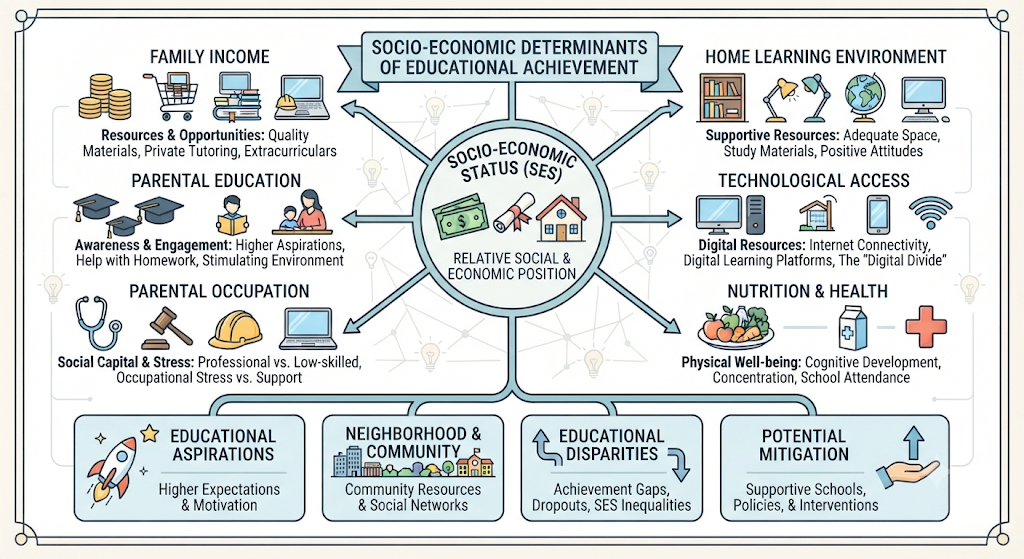
The influence of socio-economic status extends beyond individual families to broader social and community contexts. Neighbourhood characteristics, community resources, and social environments significantly affect educational experiences and outcomes. Communities characterized by poverty, inadequate infrastructure, limited educational facilities, and social disadvantage may provide fewer opportunities for academic development. In contrast, affluent communities often possess better schools, educational support services, libraries, recreational facilities, and social networks that contribute positively to students’ educational achievement.
Socio-economic inequalities frequently contribute to educational disparities among students. Achievement gaps between students from different socio-economic backgrounds have been documented across numerous educational systems worldwide. Students from disadvantaged socio-economic backgrounds often demonstrate lower academic achievement, higher dropout rates, and reduced participation in higher education compared to their more advantaged peers. Such inequalities pose significant challenges to educational equity and social justice.
Theoretical perspectives provide valuable insights into understanding the relationship between socio-economic status and academic achievement. Pierre Bourdieu’s concept of cultural capital suggests that families transmit cultural resources, values, language patterns, and educational dispositions that influence children's educational success. According to Bourdieu, children from higher socio-economic backgrounds possess cultural advantages that align more closely with school expectations, thereby facilitating academic achievement. Similarly, Bronfenbrenner’s ecological systems theory emphasizes that children's development is influenced by interactions among multiple environmental systems, including family, school, and community contexts.
Despite the substantial influence of socio-economic factors, socio-economic disadvantage does not inevitably determine poor academic outcomes. Supportive family relationships, effective schools, positive peer influences, and targeted educational interventions can mitigate the negative effects of socio-economic disadvantage. Educational policies aimed at promoting equity, providing financial assistance, improving school infrastructure, and supporting disadvantaged students can contribute significantly to reducing achievement gaps.
Parental Engagement and Home-Based Learning Support in Academic Success#
Parental engagement is one of the most important factors influencing the academic success of school students. Parents are the first teachers of a child, and the home environment created by them plays a major role in shaping students’ learning habits, discipline, motivation and educational aspirations. Academic achievement does not depend only on school teaching; it is also strongly affected by the support, encouragement and supervision received at home.
Parental engagement refers to the active participation of parents in their children’s education. It includes helping children with homework, monitoring study time, attending parent-teacher meetings, communicating with teachers, encouraging regular attendance, providing learning materials and motivating children to perform well. When parents show interest in education, children generally develop a positive attitude toward learning and become more responsible in academic activities.
Home-based learning support is a key part of parental involvement. A peaceful study space, regular study routine, availability of books, internet access, stationery and emotional encouragement help students concentrate better on their studies. Parents who guide children in completing assignments, revising lessons and preparing for examinations contribute directly to academic improvement. Even if parents are not highly educated, their encouragement and supervision can positively influence students’ confidence and performance.
Parental expectations also affect academic achievement. When parents set realistic educational goals and encourage children to work hard, students become more motivated. Positive expectations create a sense of responsibility and ambition among learners. However, excessive pressure may create stress and fear of failure. Therefore, parental engagement should be supportive rather than forceful.
Communication between parents and teachers is equally important. Regular interaction helps parents understand students’ strengths, weaknesses, behaviour and academic progress. Teachers can guide parents regarding suitable learning strategies and areas needing improvement. Such cooperation between home and school creates a strong support system for students.
Parental involvement also improves students’ discipline and study habits. Parents who monitor screen time, sleep schedule, attendance and homework help children develop self-control and time management. These habits are essential for academic success. Students who receive regular guidance at home are more likely to complete schoolwork on time and participate actively in classroom learning.
School Climate, Institutional Resources, and Students’ Learning Outcomes#
School climate and institutional resources are among the most significant determinants of students’ learning outcomes and overall educational development. Schools serve not only as centres for academic instruction but also as important social institutions that influence students’ cognitive, emotional, social, and behavioural growth. The quality of the school environment, availability of institutional resources, teacher support, and organizational practices collectively shape students’ learning experiences and academic achievement. Consequently, understanding the relationship between school climate, institutional resources, and learning outcomes is essential for improving educational quality and promoting student success.
School climate refers to the overall atmosphere, culture, relationships, values, norms, and experiences that characterize life within a school. It encompasses the physical, social, emotional, and academic environment experienced by students, teachers, administrators, and other stakeholders. A positive school climate is generally characterized by supportive teacher-student relationships, mutual respect, safety, effective communication, collaboration, discipline, and an environment conducive to learning. Conversely, a negative school climate may involve conflict, discrimination, insecurity, poor relationships, and inadequate support systems, which can adversely affect students’ learning and development.
A positive school climate significantly contributes to students’ academic achievement and learning outcomes. When students feel safe, respected, valued, and supported within the school environment, they are more likely to demonstrate higher levels of motivation, engagement, attendance, and academic performance. Supportive school environments foster students’ sense of belonging and emotional well-being, which in turn enhances concentration, participation, and learning effectiveness. Students who experience positive interactions with teachers and peers are generally more confident, motivated, and committed to academic activities.
Teacher-student relationships constitute one of the most important dimensions of school climate. Teachers play a central role in shaping students’ learning experiences, attitudes, and aspirations. Positive teacher-student relationships characterized by trust, encouragement, empathy, and effective communication contribute significantly to academic success. Teachers who provide individualized support, constructive feedback, and emotional encouragement help students develop self-confidence, intrinsic motivation, and positive attitudes toward learning. Conversely, negative teacher-student interactions may result in anxiety, disengagement, and poor academic performance.
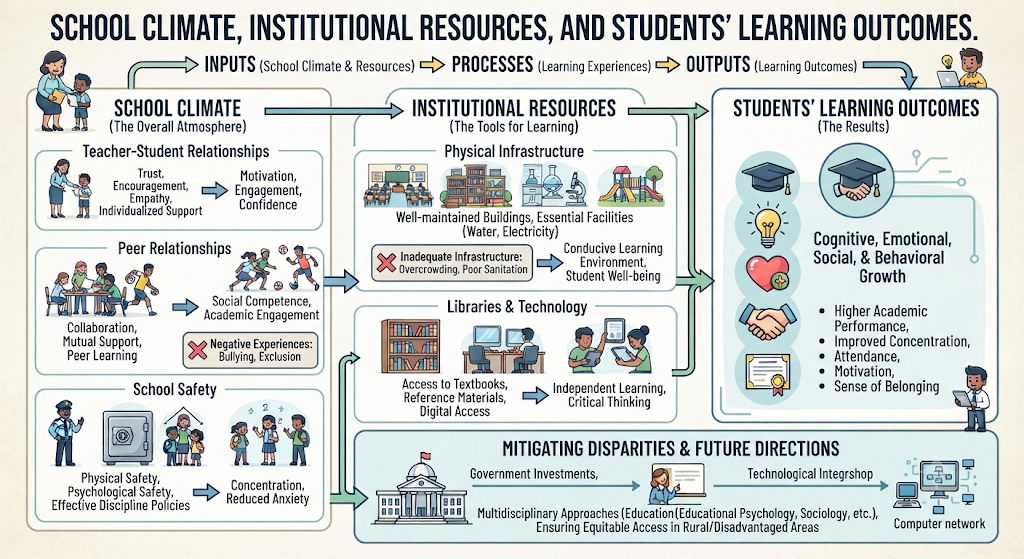
Peer relationships also influence school climate and learning outcomes. Schools provide important opportunities for social interaction, cooperation, and peer learning. Positive peer relationships promote collaboration, mutual support, social competence, and academic engagement. Peer interactions can facilitate knowledge sharing, cooperative learning, and the development of interpersonal skills. However, negative peer experiences such as bullying, exclusion, discrimination, and peer pressure may adversely affect students’ emotional well-being and academic achievement. Therefore, schools must promote inclusive and respectful peer environments that support positive social interactions.
School safety represents another critical component of school climate. Students cannot learn effectively in environments characterized by fear, violence, harassment, or insecurity. Safe and secure school environments enable students to concentrate on learning without experiencing anxiety or emotional distress. Physical safety, psychological safety, and emotional security are all essential for promoting positive learning outcomes. Schools that implement effective disciplinary policies, anti-bullying programmes, and student support services contribute significantly to creating secure learning environments.
Institutional resources constitute another major factor influencing students’ learning outcomes. Institutional resources refer to the physical, technological, instructional, and human resources available within educational institutions to support teaching and learning processes. Adequate institutional resources enhance educational quality by providing students and teachers with essential tools, facilities, and support systems necessary for effective learning.
Physical infrastructure forms the foundation of institutional resources. School buildings, classrooms, libraries, laboratories, playgrounds, sanitation facilities, electricity, drinking water, and furniture significantly influence educational experiences. Well-maintained and adequately equipped physical facilities create conducive learning environments that support academic activities and student well-being. Overcrowded classrooms, inadequate infrastructure, poor sanitation, and insufficient facilities may negatively affect students’ concentration, attendance, and academic achievement.
Libraries constitute important institutional resources that promote academic achievement and intellectual development. School libraries provide access to textbooks, reference materials, journals, newspapers, and supplementary reading resources. Availability of library facilities encourages independent learning, reading habits, critical thinking, and information literacy among students. Students who regularly utilize library resources often demonstrate improved academic performance and enhanced cognitive skills.
Theoretical perspectives provide valuable insights into understanding these relationships. Bronfenbrenner’s ecological systems theory emphasizes that educational outcomes are influenced by interactions between individuals and their environmental contexts, including schools. Similarly, school effectiveness theories highlight the importance of organizational factors, instructional practices, leadership, and school climate in determining educational outcomes.
Despite the importance of school climate and institutional resources, significant disparities exist across educational institutions, particularly in developing countries. Rural schools, economically disadvantaged communities, and marginalized populations often experience inadequate infrastructure, resource shortages, teacher scarcity, and limited technological access. Such inequalities contribute to disparities in educational achievement and opportunities.
Governments and educational policymakers therefore prioritize investments in school infrastructure, teacher development, technological integration, and school improvement programmes. Initiatives aimed at improving physical facilities, expanding digital access, strengthening teacher capacity, and promoting positive school climates contribute significantly to enhancing educational quality and learning outcomes.
A multidisciplinary perspective is essential for understanding school climate and learning outcomes. Educational psychology examines motivation and learning processes; sociology explores institutional contexts and social relationships; public administration focuses on educational management; and economics analyzes resource allocation and educational efficiency. Such interdisciplinary approaches facilitate comprehensive understanding and effective educational interventions.
Interrelationship among Family Background, School Environment, and Academic Performance#
Academic performance among school students is influenced by the combined effect of family background and school environment. A student’s learning does not take place only inside the classroom; it is shaped by the home, school, peer group and wider social surroundings. Family background provides the first foundation for learning, while the school environment strengthens academic skills, discipline, motivation and social adjustment.
Family background includes socio-economic status, parental education, occupation, income, family size, home environment and educational support. Students from supportive families generally receive proper guidance, learning materials, emotional encouragement and motivation for study. Educated parents are often more aware of academic requirements and are better able to guide children in homework, examination preparation and career planning. In contrast, students from disadvantaged family backgrounds may face lack of resources, limited study space, financial stress and reduced academic support.
School environment also plays a major role in academic performance. A positive school environment includes trained teachers, good infrastructure, proper discipline, safe classrooms, library facilities, laboratories, sports facilities and supportive teacher-student relationships. When students feel safe, respected and encouraged at school, they become more active in learning. A good school environment can also reduce the negative effect of weak family background by providing academic support, remedial teaching and emotional guidance.
The relationship between family background and school environment is highly important. If both home and school provide support, students are more likely to perform well academically. Parental involvement, regular communication with teachers and monitoring of academic progress create a strong learning system. However, if either family support or school support is weak, students may face difficulties in maintaining good academic performance.
Conclusion#
Socio-economic status, parental involvement and school environment play an important role in shaping academic achievement among school students. Students’ learning outcomes are not determined by individual ability alone; they are also influenced by family resources, parental support, school climate, teacher guidance and availability of institutional facilities. The study highlights that higher socio-economic status provides better access to educational resources, technology, nutrition and learning opportunities. Parental involvement improves motivation, discipline, study habits and confidence among students. Similarly, a positive school environment supports active learning, safety, participation and academic growth. Thus, academic achievement is the result of combined support from home, school and society. To improve students’ performance, it is necessary to reduce socio-economic inequalities, strengthen parental engagement and create supportive school environments. Effective cooperation among parents, teachers and school authorities can promote better learning outcomes and holistic development of students.
Works Cited#
- Bandura, Albert. Social Foundations of Thought and Action: A Social Cognitive Theory. Prentice Hall, 1986.
- Bourdieu, Pierre. “The Forms of Capital.” Handbook of Theory and Research for the Sociology of Education, edited by John G. Richardson, Greenwood Press, 1986, pp. 241–258.
- Bronfenbrenner, Urie. The Ecology of Human Development: Experiments by Nature and Design. Harvard UP, 1979.
- Coleman, James S. Equality of Educational Opportunity. U.S. Government Printing Office, 1966.
- Desforges, Charles, and Alberto Abouchaar. The Impact of Parental Involvement, Parental Support and Family Education on Pupil Achievement and Adjustment. Department for Education and Skills, 2003.
- Eccles, Jacquelynne S., and Allan Wigfield. “Motivational Beliefs, Values, and Goals.” Annual Review of Psychology, vol. 53, 2002, pp. 109–132.
- Epstein, Joyce L. School, Family, and Community Partnerships: Preparing Educators and Improving Schools. 2nd ed., Westview Press, 2011.
- Fan, Xitao, and Michael Chen. “Parental Involvement and Students’ Academic Achievement: A Meta-Analysis.” Educational Psychology Review, vol. 13, no. 1, 2001, pp. 1–22.
- Fraser, Barry J. Classroom Learning Environments. Routledge, 2012.
- Henderson, Anne T., and Nancy Berla, editors. A New Generation of Evidence: The Family Is Critical to Student Achievement. National Committee for Citizens in Education, 1994.
- Jeynes, William H. “A Meta-Analysis: The Effects of Parental Involvement on Minority Children’s Academic Achievement.” Education and Urban Society, vol. 35, no. 2, 2003, pp. 202–218.
- Marzano, Robert J. What Works in Schools: Translating Research into Action. ASCD, 2003.
- OECD. PISA 2018 Results: What Students Know and Can Do. OECD Publishing, 2019.
- Pianta, Robert C. Enhancing Relationships between Children and Teachers. American Psychological Association, 1999.
- Sirin, Selcuk R. “Socioeconomic Status and Academic Achievement: A Meta-Analytic Review of Research.” Review of Educational Research, vol. 75, no. 3, 2005, pp. 417–453.
- Slavin, Robert E. Educational Psychology: Theory and Practice. 12th ed., Pearson, 2018.
- UNESCO. Global Education Monitoring Report 2020: Inclusion and Education—All Means All. UNESCO, 2020.
- Walberg, Herbert J. “Educational Productivity: Theory, Evidence, and Prospects.” McCutchan Publishing Corporation, 1984.
- Wang, Margaret C., Geneva D. Haertel, and Herbert J. Walberg. “What Helps Students Learn?” Educational Leadership, vol. 51, no. 4, 1993, pp. 74–79.
"A Comparative Study of Mental Health Awareness, Help-Seeking Behaviour, and Psychological Resilience