Abstract
Artificial intelligence-driven digital learning platforms are transforming contemporary education by enabling personalized learning, adaptive feedback, learning analytics, and flexible access to academic resources. These platforms support learners by identifying individual learning needs, improving instructional delivery, and promoting self-paced learning (Zawacki-Richter et al., 2019; Holmes et al., 2022). The present study examines the impact of AI-driven digital learning platforms on academic achievement, learning engagement, and educational equity among secondary and higher education students. It explores how AI-based tools influence students’ performance, motivation, participation, and access to quality learning opportunities. The study also considers challenges such as unequal digital access, limited digital literacy, data privacy concerns, and institutional readiness, which may affect equitable learning outcomes (UNESCO, 2021). The study highlights that AI-enabled platforms can enhance academic achievement and learner engagement when supported by inclusive policies, teacher training, ethical data use, and adequate digital infrastructure.
- Artificial Intelligence
- Digital Learning Platforms
- Academic Achievement
- Learning Engagement
- Educational Equity
- Secondary Education
- Higher Education
Introduction#
Artificial Intelligence-driven digital learning platforms have emerged as an important innovation in contemporary education. These platforms use intelligent technologies such as adaptive learning, automated feedback, learning analytics, recommendation systems, virtual tutors, and personalized content delivery to support teaching and learning. In both secondary and higher education, learners are increasingly using AI-supported applications, learning management systems, smart classrooms, digital assessment tools, and online academic support platforms. These developments have changed the traditional teacher-centred approach into a more flexible, learner-centred and technology-supported learning environment.
Artificial Intelligence in education is not limited to the use of machines or software; rather, it represents a systematic attempt to understand learner behaviour, identify learning gaps, and provide suitable academic support according to individual needs. Holmes, Bialik and Fadel (2019) observed that AI in education has the potential to reshape teaching and learning by supporting personalization, assessment, feedback and learner guidance. Similarly, Zawacki-Richter et al. (2019) highlighted that AI applications in higher education are increasingly being used for profiling, prediction, assessment, intelligent tutoring and adaptive systems. Therefore, AI-driven platforms are becoming significant tools for improving academic processes and learning outcomes.
Academic achievement is one of the major concerns of every educational system. Students differ in their pace of learning, prior knowledge, motivation, language background and access to resources. Traditional classroom teaching often faces difficulty in addressing these individual differences, especially in large and diverse classrooms. AI-driven digital learning platforms can help overcome this limitation by providing personalized learning paths, instant feedback, remedial exercises and progress tracking. When students receive learning material according to their individual level, they are more likely to understand concepts, complete academic tasks and improve performance. In this sense, AI-supported learning may contribute positively to academic achievement by strengthening conceptual clarity, regular practice and self-paced learning.
Learning engagement is another important dimension of educational success. Engagement includes students’ active participation, interest, attention, motivation, interaction and emotional involvement in the learning process. AI-based platforms can increase engagement through interactive content, gamified activities, quizzes, simulations, chatbots, automated feedback and progress dashboards. These features make learning more attractive and responsive to students’ needs. UNESCO (2021) has emphasized that AI can support teaching and learning practices, but its use must be guided by ethical, inclusive and learner-centred policies. Thus, AI-driven platforms may enhance engagement only when they are used meaningfully with proper academic guidance.
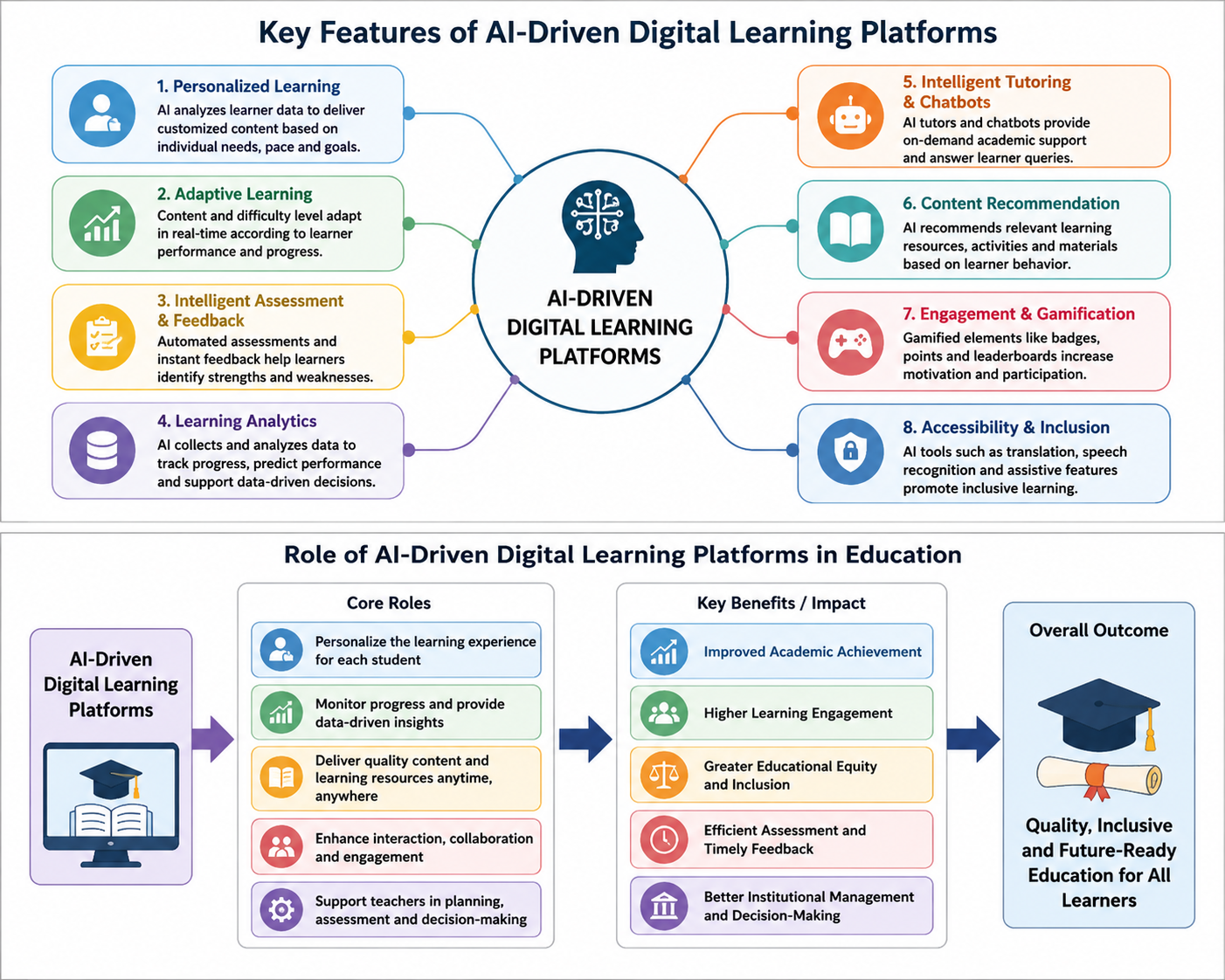
Figure 1: Conceptual Framework
In secondary education, AI-supported learning can be useful for strengthening foundational knowledge, preparing for examinations, improving language and numeracy skills, and supporting students who need additional academic help. At this stage, students require motivation, guidance and regular feedback. AI platforms can provide practice-based learning and immediate correction, which may improve confidence and learning continuity. In higher education, AI-driven platforms can support independent learning, research skills, academic writing, professional preparation and advanced subject understanding. Higher education students can use AI-enabled resources for self-directed learning, conceptual exploration and skill development.
Educational equity is a crucial concern in the use of digital learning platforms. Equity refers to fair access to quality education, learning resources and academic opportunities for all students irrespective of gender, socio-economic status, location, institution type or digital background. AI-driven platforms have the potential to reduce learning gaps by making quality resources available beyond classroom boundaries. Students from remote or disadvantaged backgrounds may benefit from digital content, recorded lectures, translation tools and adaptive learning support. However, digital learning can also increase inequality if students do not have access to devices, internet connectivity, digital skills or supportive learning environments. UNESCO (2021) cautioned that the rapid growth of AI in education brings both opportunities and risks, especially in relation to inclusion, fairness, privacy and governance.
The relevance of the present study lies in examining whether AI-driven digital learning platforms actually improve students’ academic achievement and engagement while promoting educational equity. Although AI-based tools are widely promoted as innovative educational solutions, their real impact depends on several factors such as availability of infrastructure, teacher readiness, student digital literacy, quality of content, institutional support and ethical use of data. Zawacki-Richter et al. (2019) noted that despite growing research on AI in higher education, there remains a need to understand its pedagogical value and practical implications for learners and teachers. Therefore, systematic research is required to examine how AI-supported platforms influence educational outcomes in real learning contexts.
The present study focuses on secondary and higher education students because both groups are actively exposed to digital learning environments. Secondary students represent a stage where academic foundations, study habits and learning motivation are formed. Higher education students represent a stage where independent learning, career preparation and advanced academic engagement become important. By studying both levels, the research can provide a broader understanding of how AI-driven platforms affect different categories of learners.
In the Indian educational context, the importance of digital learning has increased significantly due to the expansion of online education, smart classrooms, educational applications and technology-based teaching practices. The National Education Policy also promotes technology integration, digital resources and equitable access to quality education. In this background, AI-driven learning platforms can play an important role in improving educational quality, but their benefits must reach all sections of students. Therefore, the study of academic achievement, learning engagement and educational equity together becomes highly meaningful.
Overall, Artificial Intelligence-driven digital learning platforms offer new possibilities for transforming education through personalization, flexibility, feedback and data-based academic support. At the same time, they raise important questions related to access, fairness, privacy, teacher role and responsible use. The present study attempts to examine these dimensions by analysing the impact of AI-driven digital learning platforms on academic achievement, learning engagement and educational equity among secondary and higher education students.
Concept and Evolution of Artificial Intelligence in Education#
Artificial Intelligence has become one of the most influential technological developments in the field of education. In simple terms, Artificial Intelligence refers to the ability of machines and computer-based systems to perform tasks that usually require human intelligence, such as learning, reasoning, problem-solving, decision-making, language understanding, prediction and feedback. In education, Artificial Intelligence is used to support teaching, learning, assessment, administration and academic decision-making. It helps educational institutions to understand learner behaviour, identify learning gaps, provide personalized content, generate feedback and improve the overall learning process. According to Russell and Norvig (2021), Artificial Intelligence is concerned with the development of intelligent agents that can perceive their environment and take actions to achieve specific goals. When this concept is applied to education, AI becomes a tool that can observe student performance, analyse learning patterns and suggest suitable academic support.
The evolution of Artificial Intelligence in education can be understood through different stages of technological development. In the early phase, computers were mainly used in education for basic instructional purposes, drill-and-practice activities and computer-assisted learning. These systems provided fixed content and limited feedback. With the advancement of computing technology, intelligent tutoring systems were developed to provide more interactive and individualized learning support. Intelligent tutoring systems attempted to imitate the role of a human tutor by identifying student errors, giving hints and guiding learners step by step. Woolf (2010) explained that intelligent tutoring systems use computational models to support individualized instruction and improve learning outcomes. This stage marked an important movement from static digital learning to intelligent and responsive learning environments.
Artificial Intelligence-Driven Digital Learning Platforms: Meaning, Features and Applications#
Artificial Intelligence (AI)-driven digital learning platforms represent a significant advancement in educational technology by integrating intelligent algorithms, machine learning techniques, data analytics, and adaptive technologies into the teaching-learning process. These platforms are designed to provide personalized, interactive, and efficient learning experiences by analyzing learners’ needs, preferences, performance, and learning behaviors. Unlike conventional e-learning systems that provide uniform content to all learners, AI-driven platforms adapt instructional materials and learning pathways according to individual learner characteristics. According to Holmes et al. (2019), AI in education aims to enhance learning through intelligent systems capable of supporting personalization, assessment, feedback, and learner guidance. Consequently, AI-driven digital learning platforms have emerged as powerful tools for improving educational quality and accessibility.
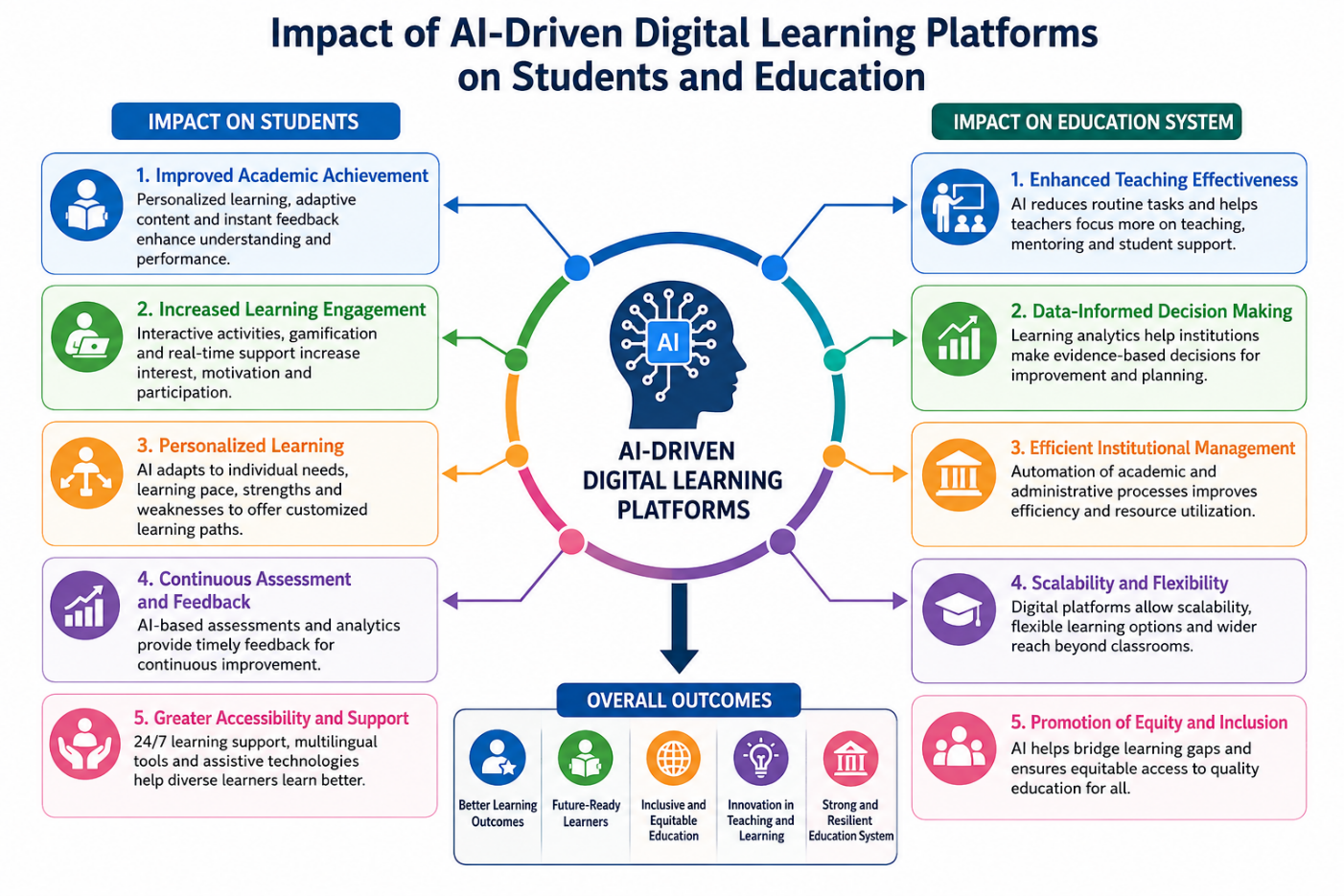
Figure 2: AI-Driven Digital Platforms
Another prominent feature is adaptive learning capability. Adaptive learning systems continuously monitor student performance and modify instructional content in real time. These systems adjust the difficulty level, sequence of topics, and type of learning activities based on learner responses. For example, if a student repeatedly makes errors in a particular concept, the platform may provide additional explanations, examples, or practice exercises. Conversely, students demonstrating mastery may progress to more advanced topics. Woolf (2010) noted that adaptive learning environments provide individualized instruction by responding dynamically to learner behavior, thereby improving learning effectiveness.
Automated assessment and immediate feedback constitute another significant feature of AI-driven learning platforms. Timely feedback is essential for effective learning because it enables students to identify errors, reinforce correct understanding, and improve academic performance. AI systems can automatically evaluate quizzes, assignments, and objective assessments, providing instant feedback to learners. Some advanced platforms can even assess written responses using natural language processing techniques. Immediate feedback not only enhances academic achievement but also increases student motivation and engagement. According to Hattie and Timperley (2007), effective feedback significantly contributes to improved learning outcomes by guiding learners toward desired educational goals.
AI-driven digital learning platforms also incorporate learning analytics and predictive capabilities. Learning analytics refers to the collection, analysis, and interpretation of educational data to understand and optimize learning processes. Through predictive analytics, AI systems can identify students who are at risk of poor academic performance, dropout, or disengagement. Educational institutions and teachers can use such information to provide timely interventions and academic support. Siemens and Long (2011) argued that learning analytics has transformed education by enabling evidence-based decision-making and personalized learner support. Consequently, predictive analytics enhances both educational effectiveness and student retention.
In addition to these features, AI-driven digital learning platforms often include gamification and interactive learning tools. Gamification involves incorporating game elements such as badges, points, leaderboards, rewards, and progress indicators into educational activities. These elements increase student motivation, participation, and persistence. Interactive videos, simulations, virtual laboratories, and augmented reality experiences further enrich learning experiences by making abstract concepts more understandable and engaging. Deterding et al. (2011) suggested that gamification enhances learner motivation by increasing enjoyment and active participation in learning tasks.
The applications of AI-driven digital learning platforms are extensive across both secondary and higher education. In secondary education, AI platforms are widely used for personalized instruction, examination preparation, remedial education, formative assessment, and skill development. Students preparing for competitive examinations frequently use AI-based applications that adapt questions according to their performance levels and provide individualized feedback. Such platforms help students strengthen foundational knowledge and improve academic achievement.
In higher education, AI-driven digital learning platforms support self-directed learning, online courses, research activities, academic writing, and professional skill development. Universities increasingly utilize AI-enabled learning management systems to monitor student progress, manage assessments, and facilitate collaborative learning. Massive Open Online Courses (MOOCs) also employ AI technologies to recommend courses, monitor learner engagement, and provide adaptive learning experiences. According to Zawacki-Richter et al. (2019), higher education institutions are increasingly adopting AI applications to enhance instructional quality, student support services, and institutional effectiveness.
AI-driven platforms also have significant applications in promoting educational equity and inclusion. Students residing in geographically remote areas or belonging to disadvantaged socio-economic backgrounds can access quality educational resources through digital platforms. Assistive technologies based on AI can support learners with disabilities through speech-to-text systems, text-to-speech applications, translation tools, and personalized accessibility features. UNESCO (2021) emphasized that AI has considerable potential to support inclusive and equitable quality education by expanding access to learning opportunities. However, the realization of this potential depends upon adequate digital infrastructure, affordability, and digital literacy.
Academic Achievement, Learning Engagement and Educational Equity in Contemporary Education#
Academic achievement, learning engagement, and educational equity are among the most significant indicators of educational quality in contemporary education. Rapid technological advancements, globalization, changing learner characteristics, and increasing educational diversity have transformed the goals and processes of education. Modern educational systems no longer focus solely on knowledge acquisition; instead, they emphasize holistic development, active participation, inclusive practices, and equitable learning opportunities for all students. Consequently, academic achievement, learning engagement, and educational equity have emerged as interconnected dimensions that determine the effectiveness and inclusiveness of educational institutions.
Academic achievement refers to the extent to which learners successfully attain educational goals, competencies, and learning outcomes prescribed by the curriculum. It is generally measured through examination scores, grades, test performance, classroom assessments, and overall scholastic attainment. Academic achievement serves as an important indicator of students' cognitive development, conceptual understanding, problem-solving abilities, and mastery of subject matter. According to Bloom (1956), educational achievement reflects the acquisition of knowledge, intellectual skills, and higher-order thinking abilities developed through systematic instruction. In contemporary education, academic achievement is increasingly viewed not merely as examination performance but also as the development of critical thinking, creativity, communication, and lifelong learning skills.
Several factors influence academic achievement, including learners' motivation, socio-economic background, learning environment, instructional quality, parental support, school resources, and individual characteristics. Contemporary educational research emphasizes that academic success is strongly associated with student engagement and access to quality learning opportunities. Hattie (2009) observed that learner-related factors, instructional practices, and educational environments significantly influence student achievement. Therefore, improving academic achievement requires a comprehensive approach that addresses both cognitive and non-cognitive dimensions of learning.
In the context of digital transformation, academic achievement has acquired new dimensions. The integration of technology into education has expanded opportunities for personalized learning, self-paced study, collaborative learning, and continuous assessment. Digital platforms, online resources, and Artificial Intelligence-supported educational tools provide students with additional opportunities to strengthen conceptual understanding and improve performance. However, academic achievement in contemporary education also depends upon students' digital competencies, access to technology, and effective utilization of learning resources. Consequently, educational institutions are increasingly focusing on innovative pedagogical approaches that promote meaningful learning and improved educational outcomes.
Learning engagement represents another critical component of educational success in contemporary education. Learning engagement refers to the degree of students' active involvement, participation, enthusiasm, commitment, and emotional investment in learning activities. It reflects the extent to which learners actively participate in educational experiences and persist in academic tasks. Fredricks, Blumenfeld, and Paris (2004) conceptualized learning engagement as a multidimensional construct comprising behavioural, emotional, and cognitive dimensions.
Behavioural engagement refers to students' participation in academic activities, attendance, classroom involvement, assignment completion, and adherence to institutional norms. Students who actively participate in discussions, attend classes regularly, and complete learning tasks demonstrate high levels of behavioural engagement. Emotional engagement includes students' feelings, attitudes, interest, enjoyment, and sense of belonging toward learning activities and educational institutions. Positive emotional engagement fosters motivation, satisfaction, and persistence in learning. Cognitive engagement involves learners' psychological investment in understanding concepts, applying critical thinking, employing effective learning strategies, and exerting effort to master challenging tasks. Highly engaged students exhibit deeper learning, self-regulation, and greater academic persistence (Fredricks et al., 2004).
Role and Significance of AI-Driven Digital Learning Platforms in Secondary and Higher Education#
Artificial Intelligence (AI)-driven digital learning platforms have emerged as transformative tools in contemporary education by redefining the methods of teaching, learning, assessment, and academic support. The rapid advancement of digital technologies, increasing access to online learning resources, and growing demand for personalized education have accelerated the integration of AI into secondary and higher education systems. These platforms employ intelligent technologies such as machine learning, natural language processing, learning analytics, adaptive algorithms, and intelligent tutoring systems to create flexible, learner-centred, and data-driven educational environments. Consequently, AI-driven digital learning platforms are playing a crucial role in enhancing educational quality, improving learning outcomes, and promoting inclusive education across different educational levels.
In secondary education, AI-driven digital learning platforms play an essential role in strengthening foundational learning and supporting students during a critical stage of cognitive and academic development. Secondary education serves as the basis for higher learning, career preparation, and personality development. At this stage, students exhibit diverse learning abilities, interests, and academic needs. Traditional classroom instruction often encounters challenges in addressing these individual differences because teachers are required to manage large and heterogeneous classrooms. AI-driven platforms address this challenge by providing personalized learning experiences tailored to students' individual abilities, pace, and learning preferences. According to Holmes et al. (2019), AI technologies facilitate personalized instruction by continuously analyzing learner performance and adapting educational content accordingly. Such individualized support enables secondary school students to strengthen conceptual understanding and improve academic performance.
One of the major contributions of AI in higher education is the promotion of self-regulated and lifelong learning. Higher education learners often differ in terms of educational background, learning goals, and career aspirations. AI-enabled learning management systems can recommend appropriate learning materials, suggest supplementary resources, monitor learning progress, and provide personalized feedback. Such support encourages students to take responsibility for their own learning and develop self-regulatory skills. Luckin et al. (2016) argued that AI technologies can augment learners' capabilities by providing individualized support that fosters autonomy and deeper learning.
AI-driven digital learning platforms also play a crucial role in supporting research and academic productivity in higher education. Students and researchers increasingly use AI-based tools for literature searching, data analysis, academic writing assistance, language improvement, plagiarism detection, and knowledge organization. Intelligent recommendation systems facilitate access to relevant scholarly resources, while data analytics tools support evidence-based research practices. These applications contribute to improved research efficiency and academic quality. However, ethical and responsible use of AI tools remains essential to maintain academic integrity and originality.
Conclusion#
Artificial Intelligence-driven digital learning platforms have become an important part of contemporary education. They support personalized learning, adaptive content, instant feedback, automated assessment and learning analytics, which can improve students’ academic achievement and learning engagement. In secondary education, these platforms help learners strengthen basic concepts, practise regularly and receive timely academic support. In higher education, they promote self-directed learning, research skills, flexible access to resources and professional development.
The study also shows that AI-driven platforms have strong potential to promote educational equity by providing learning opportunities beyond the limits of classrooms, institutions and geographical locations. However, their benefits depend on equal access to digital devices, internet connectivity, digital literacy, trained teachers and ethical use of student data. If these challenges are not addressed, AI-based learning may widen existing educational inequalities.
Thus, AI-driven digital learning platforms should be viewed as supportive tools rather than replacements for teachers. Their effective use requires a balanced relationship between technology and human guidance. When implemented with proper infrastructure, inclusive policies, teacher training and ethical safeguards, AI-driven platforms can significantly enhance academic achievement, learning engagement and educational equity among secondary and higher education students.
Works Cited#
- Baker, Ryan S., and Paul S. Inventado. “Educational Data Mining and Learning Analytics.” Learning Analytics: From Research to Practice, Springer, 2014.
- Bloom, Benjamin S. Taxonomy of Educational Objectives: The Classification of Educational Goals. Longmans, 1956.
- Deterding, Sebastian, et al. “From Game Design Elements to Gamefulness: Defining Gamification.” Proceedings of the 15th International Academic MindTrek Conference, 2011.
- Fredricks, Jennifer A., Phyllis C. Blumenfeld, and Alison H. Paris. “School Engagement: Potential of the Concept, State of the Evidence.” Review of Educational Research, vol. 74, no. 1, 2004, pp. 59–109.
- Hattie, John. Visible Learning: A Synthesis of Over 800 Meta-Analyses Relating to Achievement. Routledge, 2009.
- Hattie, John, and Helen Timperley. “The Power of Feedback.” Review of Educational Research, vol. 77, no. 1, 2007, pp. 81–112.
- Holmes, Wayne, Maya Bialik, and Charles Fadel. Artificial Intelligence in Education: Promises and Implications for Teaching and Learning. Center for Curriculum Redesign, 2019.
- Kuh, George D. “What Student Affairs Professionals Need to Know about Student Engagement.” Journal of College Student Development, vol. 50, no. 6, 2009, pp. 683–706.
- Luckin, Rose, et al. Intelligence Unleashed: An Argument for AI in Education. Pearson, 2016.
- Russell, Stuart, and Peter Norvig. Artificial Intelligence: A Modern Approach. 4th ed., Pearson, 2021.
- Selwyn, Neil. Should Robots Replace Teachers? AI and the Future of Education. Polity Press, 2019.
- Siemens, George, and Phil Long. “Penetrating the Fog: Analytics in Learning and Education.” EDUCAUSE Review, vol. 46, no. 5, 2011, pp. 30–40.
- UNESCO. AI and Education: Guidance for Policy-Makers. UNESCO, 2021.
- UNESCO. Global Education Monitoring Report 2020: Inclusion and Education: All Means All. UNESCO, 2020.
- United Nations. Transforming Our World: The 2030 Agenda for Sustainable Development. United Nations, 2015.
- Woolf, Beverly Park. Building Intelligent Interactive Tutors: Student-Centered Strategies for Revolutionizing E-Learning. Morgan Kaufmann, 2010.
- Zawacki-Richter, Olaf, et al. “Systematic Review of Research on Artificial Intelligence Applications in Higher Education.” International Journal of Educational Technology in Higher Education, vol. 16, no. 1, 2019.
- Roll, Ido, and Ruth Wylie. “Evolution and Revolution in Artificial Intelligence in Education.” International Journal of Artificial Intelligence in Education, vol. 26, 2016, pp. 582–599.
- Baker, Ryan S., and Kalina Yacef. “The State of Educational Data Mining in 2009: A Review and Future Visions.” Journal of Educational Data Mining, vol. 1, no. 1, 2009, pp. 3–17.
- Popenici, Stefan A. D., and Sharon Kerr. “Exploring the Impact of Artificial Intelligence on Teaching and Learning in Higher Education.” Research and Practice in Technology Enhanced Learning, vol. 12, no. 1, 2017.
"Influence of Social Media Usage on Psychological Well-Being, Self-Esteem, and Interpersonal Relationships among