Abstract
The present study examines the role of game-based elements in improving classroom learning. The present study titled “Impact of Gamification-Based Learning Strategies on Student Engagement, Motivation, and Academic Performance in School Education” examines the role of game-based elements in improving classroom learning. Gamification-based learning refers to the use of game elements such as points, badges, rewards, levels, leaderboards, quizzes, challenges, feedback, competition, and teamwork in the teaching-learning process. These strategies make learning more interesting, interactive, and student-centered.
- Gamification-Based Learning
- Student Engagement
- Student Motivation
- Academic Performance
- School Education
- Game Elements
- Interactive Learning
- Classroom Participation
- Learning Strategies
- Educational Innovation
Introduction#
Education is a continuous process of developing knowledge, skills, values, attitudes, and abilities among students. In school education, effective teaching-learning strategies are necessary for improving student participation, motivation, and academic performance. Traditional teaching methods often depend mainly on lectures, textbooks, memorization, and examinations. Although these methods are useful in many situations, they may not always create active interest among students. Many students become passive learners and may lose attention during classroom teaching.
In the present digital and learner-centered educational environment, teachers are encouraged to use innovative methods that make learning more active, enjoyable, and meaningful. One such method is gamification-based learning. Gamification means the use of game-like elements in non-game educational settings. It does not necessarily mean playing complete games in the classroom; rather, it means using elements such as points, badges, rewards, levels, challenges, missions, leaderboards, quizzes, instant feedback, and teamwork to make learning more engaging.
Gamification-based learning is based on the idea that students learn better when they are actively involved in the learning process. Game elements create curiosity, excitement, challenge, and a sense of achievement. When students receive points or rewards for completing tasks, answering questions, solving problems, or participating in activities, they feel encouraged to continue learning. This improves classroom engagement and reduces boredom.
Student engagement is one of the major factors influencing learning outcomes. Engagement refers to students’ attention, interest, participation, emotional involvement, and active effort in learning activities. Gamification increases engagement by making lessons interactive and goal-oriented. Students become more willing to participate in quizzes, discussions, group tasks, and problem-solving activities when learning is presented in an interesting format.
Motivation is another important aspect of gamification. Motivation refers to the inner desire and external encouragement that push students to learn and perform better. Gamification can support both intrinsic and extrinsic motivation. Intrinsic motivation develops when students enjoy learning and feel satisfied by completing challenges. Extrinsic motivation develops through rewards, badges, points, ranks, and recognition. A balanced use of both types of motivation can improve learning interest.
Academic performance refers to students’ achievement in tests, assignments, examinations, classroom activities, and overall learning outcomes. Gamification may improve academic performance by encouraging regular practice, immediate feedback, repetition, active participation, and better understanding of concepts. When students learn through challenges and activities, they may remember concepts more effectively.
In school education, gamification can be applied in different subjects such as science, mathematics, social science, language, environmental studies, and computer education. Teachers can use quiz competitions, digital learning apps, classroom reward systems, team challenges, flashcards, puzzles, storytelling missions, and level-based tasks to support learning. These methods make difficult topics easier and more enjoyable. However, gamification must be used carefully. If it focuses only on rewards and competition, some students may feel pressure or discouragement. Therefore, teachers should ensure that gamification promotes cooperation, learning, creativity, and confidence rather than unhealthy competition. Game elements should be linked with clear learning objectives and should support meaningful academic growth.
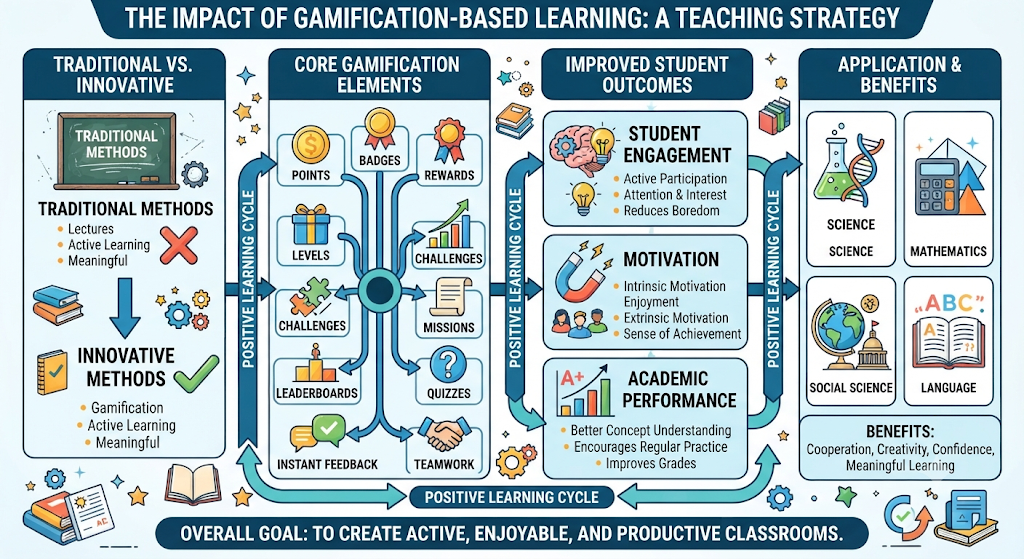
The present study is significant because it examines the effectiveness of gamification as an innovative teaching strategy. It helps in understanding how game-based elements influence students’ learning behaviour and academic outcomes. The study may be useful for teachers, school administrators, curriculum developers, parents, and educational policymakers. By using gamification effectively, schools can create more active, enjoyable, and productive classrooms. Thus, gamification-based learning can become an important tool for improving student engagement, motivation, and academic performance in school education.
Conceptual Framework and Theoretical Foundations of Gamification-Based Learning#
Gamification-based learning is an innovative educational strategy that uses game-like elements in the teaching-learning process to make learning more interesting, active, and meaningful. It does not mean converting the entire classroom into a game; rather, it means applying selected game elements such as points, badges, levels, rewards, leaderboards, challenges, missions, feedback, storytelling, competition, and collaboration within academic activities. The main purpose of gamification is to increase students’ interest, attention, participation, motivation, and learning achievement.
In school education, students often face problems such as lack of concentration, low motivation, fear of failure, passive classroom participation, and examination pressure. Traditional teaching methods sometimes make students dependent on lectures and memorization. Gamification-based learning helps overcome these limitations by making learning more interactive and student-centered. When lessons are presented through challenges, quizzes, rewards, tasks, and levels, students become more actively involved in the learning process.
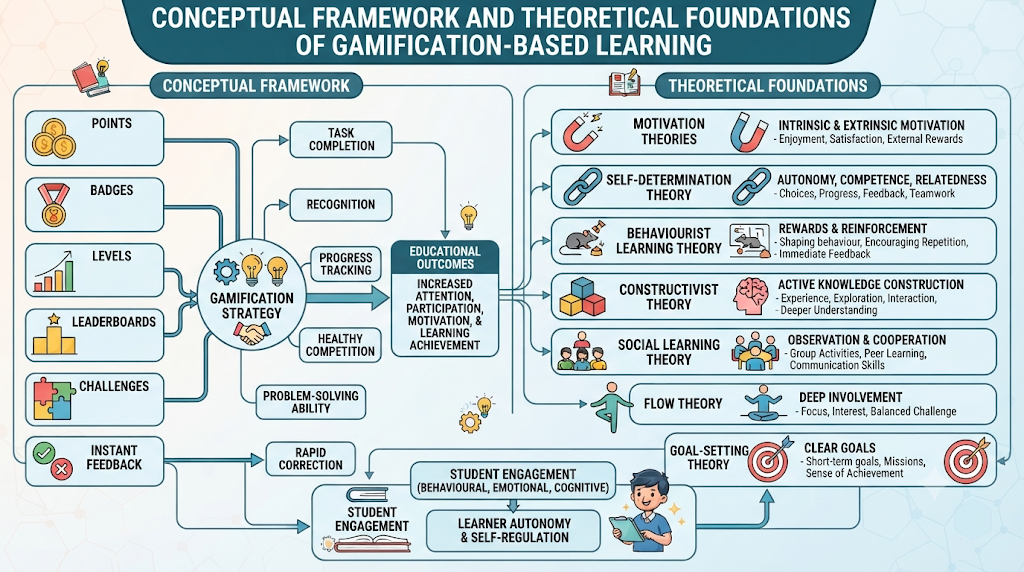
The conceptual framework of gamification-based learning is based on the connection between game elements and educational outcomes. Game elements act as learning tools that influence student engagement, motivation, classroom participation, and academic performance. For example, points encourage students to complete tasks; badges provide recognition; levels show progress; leaderboards create healthy competition; challenges develop problem-solving ability; and instant feedback helps students correct mistakes quickly.
Gamification is different from game-based learning. In game-based learning, complete games are used for educational purposes. For example, a mathematics game may be used to teach calculation or a science game may be used to explain experiments. In gamification, the subject matter remains the same, but game-like features are added to regular classroom activities. For example, a teacher may give points for correct answers, badges for completing assignments, or levels for mastering chapters.
Gamification is also different from simple digital learning. Digital learning means using digital devices and online resources for teaching and learning. Gamification may use digital tools, but it can also be used without technology. A teacher can gamify a classroom using paper cards, quiz rounds, group challenges, reward charts, classroom missions, and board activities. Thus, gamification is a teaching strategy, not only a technological method.
The theoretical foundation of gamification is linked with motivation theories. Motivation is an important factor in learning because students learn better when they are interested and willing to make effort. Gamification supports both intrinsic and extrinsic motivation. Intrinsic motivation develops when students enjoy learning and feel satisfied after completing a challenge. Extrinsic motivation develops through external rewards such as points, badges, praise, rankings, and certificates. A balanced combination of both types of motivation makes learning more effective.
Self-Determination Theory is one important theory related to gamification. This theory emphasizes three psychological needs: autonomy, competence, and relatedness. Autonomy means students feel they have some control over learning. Competence means students feel capable of completing tasks. Relatedness means students feel connected with classmates and teachers. Gamification supports these needs by giving choices, showing progress, providing feedback, and encouraging teamwork.
Behaviourist learning theory also supports gamification. According to this approach, rewards and reinforcement can shape behaviour. When students receive points, praise, badges, or recognition after completing academic tasks, they feel encouraged to repeat positive learning behaviour. Immediate feedback in gamification works as reinforcement and helps students understand what they did correctly or incorrectly.
Constructivist theory is also relevant to gamification-based learning. Constructivism states that students learn best when they actively construct knowledge through experience, exploration, interaction, and problem-solving. Gamified activities such as missions, puzzles, projects, quizzes, and group challenges allow students to participate actively rather than passively listening to lectures. This supports deeper understanding and meaningful learning.
Social learning theory also explains the importance of gamification. Students learn by observing others, cooperating with peers, and participating in group activities. Leaderboards, team challenges, peer competition, and group rewards encourage social interaction. Students learn from classmates and develop teamwork, communication, and cooperation skills.
Flow theory is another important theoretical base of gamification. Flow refers to a state of deep involvement in an activity where learners feel focused, interested, and fully engaged. Gamification can create flow when tasks are neither too easy nor too difficult. Properly designed challenges, levels, and feedback help students remain interested and continue learning with concentration.
Goal-setting theory is also connected with gamification. Learning becomes more effective when students have clear goals. Gamification provides short-term goals through tasks, missions, levels, and achievement targets. When students complete one level, they feel motivated to move to the next. This creates a sense of progress and achievement.
In gamification-based learning, feedback is very important. Traditional classrooms often provide feedback after tests or examinations, but gamification provides quick or immediate feedback through scores, progress bars, hints, correction points, or teacher responses. This helps students understand their mistakes and improve continuously. Immediate feedback also reduces fear of failure because mistakes become part of the learning process.
The conceptual framework also includes student engagement as a central outcome. Engagement includes behavioural engagement, emotional engagement, and cognitive engagement. Behavioural engagement means active participation in activities. Emotional engagement means interest, enjoyment, and positive feelings toward learning. Cognitive engagement means attention, thinking, and effort to understand concepts. Gamification supports all these forms of engagement.
Gamification also supports learner autonomy. Students may choose tasks, complete challenges at their own pace, track their progress, and take responsibility for learning. This develops self-regulated learning habits. When students know their progress and goals, they become more independent and disciplined learners.
In school education, gamification can be applied in different ways. Teachers can use quiz competitions, point systems, reward charts, classroom missions, group challenges, puzzle-based learning, digital apps, flashcards, badges, storytelling, and level-based assignments. These strategies can be used in subjects such as mathematics, science, language, social science, environmental studies, and computer education.
However, gamification must be planned carefully. If the focus remains only on rewards, students may become dependent on prizes and may not develop genuine interest in learning. If competition is too strong, weaker students may feel discouraged. Therefore, gamification should encourage cooperation, effort, improvement, creativity, and meaningful learning rather than only ranking and winning.
The teacher has an important role in gamification-based learning. The teacher must select suitable game elements, connect them with learning objectives, maintain classroom discipline, provide fair opportunities, and ensure that all students participate. Gamification should be inclusive so that students with different abilities and learning speeds can benefit from it.
Impact of Gamification-Based Learning on Student Engagement#
Gamification-based learning has a strong impact on student engagement because it makes the teaching-learning process more active, interesting, and participatory. Student engagement refers to the level of attention, interest, involvement, effort, and emotional connection that students show during learning activities. In school education, student engagement is very important because engaged students participate more actively, understand lessons better, complete tasks regularly, and show greater interest in academic activities.
In many traditional classrooms, students may become passive listeners. They may attend classes physically but may not remain mentally involved in learning. Long lectures, repetitive teaching methods, fear of mistakes, and lack of interaction may reduce classroom engagement. Gamification helps address this issue by introducing game-like features such as points, rewards, levels, challenges, quizzes, badges, missions, leaderboards, and instant feedback into lessons. These elements create curiosity and encourage students to participate actively.
One of the major ways gamification improves engagement is by increasing attention. When students know that a quiz, challenge, puzzle, or task is part of the lesson, they become more alert and focused. Game-based elements break the monotony of regular teaching and make students eager to know what will happen next. This sense of curiosity helps sustain attention during classroom learning.
Gamification also promotes behavioural engagement. Behavioural engagement means students’ active participation in learning activities. In a gamified classroom, students are encouraged to answer questions, complete tasks, join group activities, solve problems, and participate in discussions. Points, badges, and rewards provide visible recognition for participation. This motivates even shy or less active students to become involved in classroom activities.
Emotional engagement is also strengthened through gamification. Students often feel happy and excited when learning is presented in the form of challenges and achievements. Earning points, moving to the next level, receiving appreciation, or completing a mission gives students a sense of success. These positive emotions reduce boredom and fear, making students more comfortable in the learning environment.
Gamification also supports cognitive engagement. Cognitive engagement refers to mental effort, thinking, understanding, and problem-solving. Gamified activities such as puzzles, quizzes, role plays, problem-solving missions, and subject-based challenges encourage students to think deeply. Instead of memorizing content only, students apply concepts in interactive situations. This increases understanding and strengthens learning.
Another important impact of gamification is increased classroom participation. In a gamified lesson, students are not only receivers of information; they become active participants. For example, a teacher may divide the class into teams and assign a science quiz, mathematics challenge, vocabulary game, or social science mission. Such activities encourage students to discuss, cooperate, think quickly, and respond confidently.
Gamification also helps in reducing hesitation among students. Some students avoid answering questions due to fear of being wrong. In gamified learning, mistakes are treated as part of the learning process. Instant feedback, retry options, and supportive scoring systems help students correct errors without feeling embarrassed. This creates a safe learning environment and encourages participation.
Healthy competition is another factor that increases engagement. Leaderboards, team scores, and achievement levels can motivate students to perform better. However, competition should be balanced and positive. If competition becomes too intense, weaker students may feel discouraged. Therefore, teachers should use gamification in a way that rewards effort, improvement, teamwork, and participation, not only high scores.
Gamification also encourages collaboration. Many gamified activities can be designed as team-based tasks. Students work together to solve problems, complete missions, or achieve group rewards. This promotes teamwork, communication, cooperation, and peer learning. Students learn not only from the teacher but also from one another.
The use of immediate feedback is a powerful feature of gamification. In traditional learning, students may receive feedback after exams or assignments. In gamification, feedback is often immediate through scores, hints, corrections, progress indicators, or teacher responses. Immediate feedback helps students understand their mistakes quickly and remain engaged in improvement.
Gamification also supports sustained engagement over time. Levels, missions, progress bars, and achievement systems show students that learning is a journey. When students complete one level, they feel motivated to reach the next. This creates continuity and helps maintain interest across lessons or chapters.
Student engagement also improves because gamification provides clear goals. Students know what they have to achieve, how they will be assessed, and what rewards or progress they can earn. Clear goals reduce confusion and increase learning direction. When students understand the purpose of an activity, they are more likely to participate seriously.
Gamification can make difficult subjects more approachable. Many students feel fear or boredom in subjects such as mathematics, science, grammar, or history. When these subjects are taught through quizzes, puzzles, flashcards, challenges, or storytelling missions, students find them easier and more enjoyable. This reduces negative attitudes toward learning.
Digital gamification tools can further enhance engagement. Educational apps, online quizzes, smart boards, interactive games, and learning platforms provide attractive visuals, instant results, and enjoyable practice. However, gamification does not always require technology. Teachers can use classroom charts, cards, stickers, group tasks, reward boards, and oral quiz games to create engagement.
Gamification is especially useful for diverse learners. Some students learn better through visual activities, some through movement, some through competition, and some through teamwork. Gamified learning provides multiple ways to participate. This makes the classroom more inclusive and student-centered.
Teacher creativity plays an important role in student engagement through gamification. A teacher must design activities according to students’ age, subject, ability level, and learning objectives. If game elements are not connected with learning goals, they may become mere entertainment. Therefore, gamification should be meaningful and educational.
The classroom environment also becomes more positive through gamification. Students often enjoy interactive activities and feel more connected with teachers and classmates. A lively classroom atmosphere increases motivation and reduces stress. When students enjoy learning, they are more likely to attend classes regularly and participate actively.
However, there are some limitations. If gamification is overused, students may focus only on rewards rather than learning. Some students may feel anxious due to leaderboards or competition. Others may lose interest if rewards are repeated too often. Therefore, gamification should be used carefully, with balance between fun and academic purpose.
Influence of Gamification on Student Motivation#
Gamification has a strong influence on student motivation because it makes learning more goal-oriented, enjoyable, and rewarding. Motivation refers to the inner desire and external encouragement that push students to learn, participate, complete tasks, and improve performance. In school education, motivation is very important because motivated students show greater interest, effort, confidence, and persistence in learning activities.
Many students lose motivation when lessons are difficult, repetitive, or examination-centered. They may feel bored, afraid of failure, or disconnected from classroom learning. Gamification helps reduce this problem by adding game-like elements such as points, badges, levels, rewards, challenges, leaderboards, missions, and instant feedback. These elements make learning feel more active and meaningful.
Gamification supports both intrinsic and extrinsic motivation. Intrinsic motivation comes from enjoyment, curiosity, satisfaction, and personal interest in learning. When students enjoy solving a puzzle, completing a challenge, or moving to the next level, they feel internally motivated. Extrinsic motivation comes from external rewards such as points, badges, certificates, praise, or recognition. These rewards encourage students to complete tasks and participate actively.
Goal-setting is an important motivational feature of gamification. In a gamified classroom, students know what task they have to complete and what achievement they can earn. Clear goals help students remain focused. For example, a student may try to complete a quiz level, earn a badge for regular homework, or reach a team target. These small goals create continuous motivation.
Gamification also increases confidence. When students receive immediate feedback and small rewards for effort, they begin to believe that they can improve. Even weaker students may feel encouraged when they are rewarded for participation, improvement, teamwork, or regular effort. This improves self-confidence and reduces fear of failure.
Achievement systems such as badges, stars, levels, and progress charts motivate students because they make learning progress visible. Students can see how far they have reached and what they need to do next. This sense of progress creates satisfaction and encourages continuous effort.
Competition can also motivate students when used positively. Leaderboards, quiz contests, and team challenges can encourage students to perform better. However, competition should be healthy and balanced. Teachers should avoid creating pressure or discouragement among low-performing students. Rewards should be given not only for high scores but also for effort, creativity, discipline, and improvement.
Gamification promotes active learning motivation. Students do not remain passive listeners; they become active participants in classroom tasks. They answer questions, solve problems, join group activities, and complete missions. This active involvement makes learning more interesting and increases motivation.
Team-based gamification also develops social motivation. When students work in groups, they encourage one another and feel responsible for team success. This promotes cooperation, communication, peer support, and shared achievement. Students who are less confident individually may feel more motivated when supported by their team.
Instant feedback is another major motivational factor. In traditional teaching, students often receive feedback after tests or assignments. In gamification, feedback is quick through scores, hints, progress indicators, teacher comments, or peer responses. Immediate feedback helps students correct mistakes and continue learning without losing interest.
Gamification also reduces anxiety by making learning playful. When students see tasks as challenges rather than burdens, they feel more relaxed. A game-like environment can reduce examination fear, classroom hesitation, and fear of wrong answers. Students learn that mistakes are part of improvement.
Motivation through gamification is also linked with autonomy. When students get choices in tasks, levels, roles, or activities, they feel more control over learning. This increases responsibility and self-regulation. Students become more willing to plan, attempt, and complete learning tasks.
Gamification can be especially useful in difficult subjects. Subjects such as mathematics, science, grammar, and history may seem difficult or boring to some students. When these subjects are taught through quiz rounds, puzzles, story missions, flashcards, and reward systems, students become more willing to learn.
However, gamification should not depend only on prizes or rankings. If students learn only for rewards, their real interest in learning may decrease. Therefore, teachers should design gamification in a way that develops curiosity, effort, understanding, teamwork, and self-improvement.
The teacher’s role is very important in maintaining motivation. Teachers should encourage all students, provide fair chances, appreciate effort, and ensure that game elements are connected with learning objectives. A supportive teacher can use gamification to build confidence rather than pressure.
Effect of Gamification-Based Learning on Academic Performance and Educational Outcomes#
Gamification has a strong influence on student motivation because it makes learning more goal-oriented, enjoyable, and rewarding. Motivation refers to the inner desire and external encouragement that push students to learn, participate, complete tasks, and improve performance. In school education, motivation is very important because motivated students show greater interest, effort, confidence, and persistence in learning activities.
Many students lose motivation when lessons are difficult, repetitive, or examination-centered. They may feel bored, afraid of failure, or disconnected from classroom learning. Gamification helps reduce this problem by adding game-like elements such as points, badges, levels, rewards, challenges, leaderboards, missions, and instant feedback. These elements make learning feel more active and meaningful.
Gamification supports both intrinsic and extrinsic motivation. Intrinsic motivation comes from enjoyment, curiosity, satisfaction, and personal interest in learning. When students enjoy solving a puzzle, completing a challenge, or moving to the next level, they feel internally motivated. Extrinsic motivation comes from external rewards such as points, badges, certificates, praise, or recognition. These rewards encourage students to complete tasks and participate actively.
Goal-setting is an important motivational feature of gamification. In a gamified classroom, students know what task they have to complete and what achievement they can earn. Clear goals help students remain focused. For example, a student may try to complete a quiz level, earn a badge for regular homework, or reach a team target. These small goals create continuous motivation.
Gamification also increases confidence. When students receive immediate feedback and small rewards for effort, they begin to believe that they can improve. Even weaker students may feel encouraged when they are rewarded for participation, improvement, teamwork, or regular effort. This improves self-confidence and reduces fear of failure.
Achievement systems such as badges, stars, levels, and progress charts motivate students because they make learning progress visible. Students can see how far they have reached and what they need to do next. This sense of progress creates satisfaction and encourages continuous effort.
Competition can also motivate students when used positively. Leaderboards, quiz contests, and team challenges can encourage students to perform better. However, competition should be healthy and balanced. Teachers should avoid creating pressure or discouragement among low-performing students. Rewards should be given not only for high scores but also for effort, creativity, discipline, and improvement.
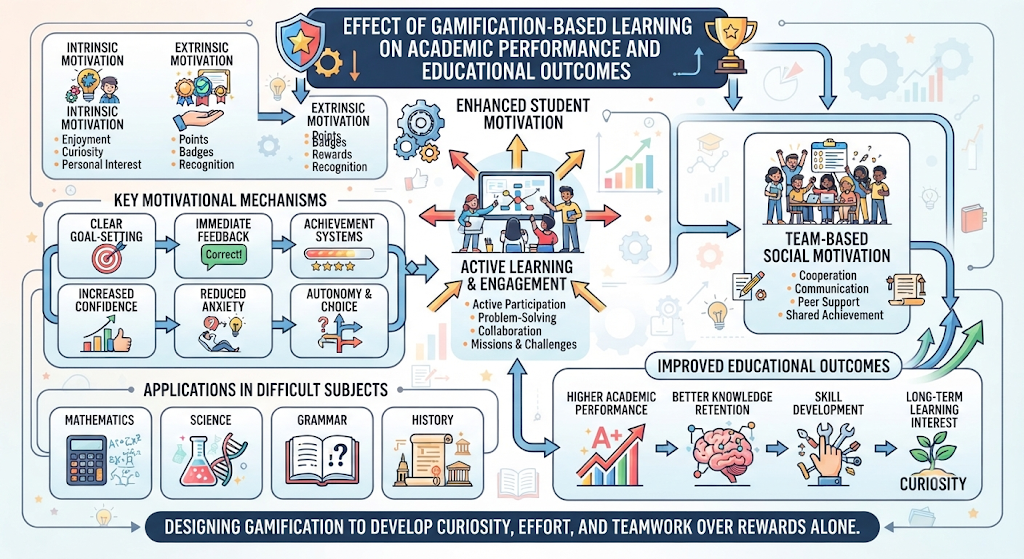
Gamification promotes active learning motivation. Students do not remain passive listeners; they become active participants in classroom tasks. They answer questions, solve problems, join group activities, and complete missions. This active involvement makes learning more interesting and increases motivation.
Team-based gamification also develops social motivation. When students work in groups, they encourage one another and feel responsible for team success. This promotes cooperation, communication, peer support, and shared achievement. Students who are less confident individually may feel more motivated when supported by their team.
Instant feedback is another major motivational factor. In traditional teaching, students often receive feedback after tests or assignments. In gamification, feedback is quick through scores, hints, progress indicators, teacher comments, or peer responses. Immediate feedback helps students correct mistakes and continue learning without losing interest.
Gamification also reduces anxiety by making learning playful. When students see tasks as challenges rather than burdens, they feel more relaxed. A game-like environment can reduce examination fear, classroom hesitation, and fear of wrong answers. Students learn that mistakes are part of improvement.
Motivation through gamification is also linked with autonomy. When students get choices in tasks, levels, roles, or activities, they feel more control over learning. This increases responsibility and self-regulation. Students become more willing to plan, attempt, and complete learning tasks.
Gamification can be especially useful in difficult subjects. Subjects such as mathematics, science, grammar, and history may seem difficult or boring to some students. When these subjects are taught through quiz rounds, puzzles, story missions, flashcards, and reward systems, students become more willing to learn.
However, gamification should not depend only on prizes or rankings. If students learn only for rewards, their real interest in learning may decrease. Therefore, teachers should design gamification in a way that develops curiosity, effort, understanding, teamwork, and self-improvement.
Conclusion#
The study concludes that gamification-based learning strategies have a positive impact on student engagement, motivation, and academic performance in school education. By using game elements such as points, badges, levels, rewards, challenges, quizzes, leaderboards, and instant feedback, classroom learning becomes more interactive, enjoyable, and student-centered.
Gamification increases student engagement by encouraging active participation, attention, curiosity, teamwork, and classroom involvement. It also improves motivation by creating clear goals, achievement opportunities, recognition, confidence, and interest in learning. Students feel more willing to complete tasks and participate in academic activities when learning is presented in an interesting and rewarding manner.
The study further concludes that gamification can improve academic performance by promoting regular practice, better understanding, immediate feedback, problem-solving, and revision. It helps students learn difficult concepts in a more enjoyable and meaningful way. However, gamification should be used carefully so that students do not focus only on rewards or unhealthy competition. The gamification-based learning is an effective educational strategy when it is properly planned, linked with learning objectives, and guided by teachers. It can make school education more active, creative, motivating, and result-oriented.
Works Cited#
- Deterding, Sebastian, et al. “From Game Design Elements to Gamefulness: Defining Gamification.” Proceedings of the 15th International Academic MindTrek Conference, 2011, pp. 9–15.
- Deci, Edward L., and Richard M. Ryan. Intrinsic Motivation and Self-Determination in Human Behavior. Plenum Press, 1985.
- Kapp, Karl M. The Gamification of Learning and Instruction. Pfeiffer, 2012.
- Kapp, Karl M., Lucas Blair, and Rich Mesch. The Gamification of Learning and Instruction Fieldbook. Wiley, 2014.
- Zichermann, Gabe, and Christopher Cunningham. Gamification by Design. O’Reilly Media, 2011.
- Werbach, Kevin, and Dan Hunter. For the Win: How Game Thinking Can Revolutionize Your Business. Wharton Digital Press, 2012.
- Gee, James Paul. What Video Games Have to Teach Us about Learning and Literacy. Palgrave Macmillan, 2003.
- Prensky, Marc. Digital Game-Based Learning. McGraw-Hill, 2001.
- Hamari, Juho, Jonna Koivisto, and Harri Sarsa. “Does Gamification Work? A Literature Review of Empirical Studies on Gamification.” Proceedings of the 47th Hawaii International Conference on System Sciences, 2014, pp. 3025–3034.
- Domínguez, Adrián, et al. “Gamifying Learning Experiences: Practical Implications and Outcomes.” Computers & Education, vol. 63, 2013, pp. 380–392.
- Hamari, Juho, and Jonna Koivisto. “Social Motivations to Use Gamification.” Proceedings of the 21st European Conference on Information Systems, 2013.
- Landers, Richard N. “Developing a Theory of Gamified Learning.” Simulation & Gaming, vol. 45, no. 6, 2014, pp. 752–768.
- Lee, Joey J., and Jessica Hammer. “Gamification in Education: What, How, Why Bother?” Academic Exchange Quarterly, vol. 15, no. 2, 2011, pp. 146–151.
- Malone, Thomas W. “Toward a Theory of Intrinsically Motivating Instruction.” Cognitive Science, vol. 5, no. 4, 1981, pp. 333–369.
- Nicholson, Scott. “A User-Centered Theoretical Framework for Meaningful Gamification.” Games+Learning+Society 8.0, 2012.
- Ryan, Richard M., and Edward L. Deci. “Self-Determination Theory and the Facilitation of Intrinsic Motivation.” American Psychologist, vol. 55, no. 1, 2000, pp. 68–78.