Abstract
The present study examines the role of continuous teacher training in improving classroom teaching and students’ academic progress. Teacher professional development programmes include workshops, refresher courses, orientation programmes, seminars, mentoring, peer learning, digital training, curriculum training, and subject-specific skill enhancement activities.
- Teacher Professional Development
- Instructional Effectiveness
- Student Learning Outcomes
- Teacher Training
- Teaching Quality
- Classroom Management
- Pedagogy
- Student Achievement
- Educational Improvement
- Professional Growth
Introduction#
Teacher professional development is an essential component of quality education. Teachers are the key agents of educational change because they directly influence classroom learning, student motivation, academic achievement, and overall personality development. In the changing educational environment, teachers are expected to update their knowledge, improve teaching methods, use technology, manage diverse classrooms, and adopt student-centered approaches. Therefore, continuous professional development is necessary for improving teaching quality.
Teacher professional development refers to planned learning activities that help teachers improve their professional knowledge, skills, attitudes, and competencies. These activities may include workshops, seminars, refresher courses, orientation programmes, in-service training, peer discussion, mentoring, classroom observation, online courses, research activities, and subject-based training. Such programmes help teachers remain updated with new curriculum, teaching strategies, assessment methods, educational technology, and classroom innovations.
Instructional effectiveness refers to the ability of teachers to teach in a clear, meaningful, organized, and learner-friendly manner. Effective instruction includes proper lesson planning, clear explanation, active student participation, use of teaching aids, classroom interaction, continuous assessment, feedback, and individual attention. A professionally trained teacher is more capable of making lessons interesting, understandable, and suitable for different types of learners.
Student learning outcomes are the knowledge, skills, understanding, attitudes, and performance achieved by students through the teaching-learning process. These outcomes may be reflected in examination scores, classroom participation, conceptual clarity, problem-solving ability, communication skills, creativity, confidence, and motivation. When teachers improve their teaching practices through professional development, students are more likely to show better learning outcomes.
Professional development programmes are especially important in the present era because education is continuously changing. New pedagogical approaches, digital tools, inclusive education practices, competency-based learning, experiential learning, and continuous assessment systems require teachers to develop new skills. Without proper training, teachers may continue to use traditional methods that may not fully meet the needs of modern learners.
The effectiveness of teacher professional development depends on its quality, relevance, duration, follow-up support, and practical application. Short and theory-based training may have limited impact if teachers do not receive opportunities to apply new learning in classrooms. Effective professional development should be need-based, practical, continuous, collaborative, and linked with classroom realities.
Concept and Importance of Teacher Professional Development Programmes#
Teacher professional development programmes are organized activities designed to improve the knowledge, skills, attitudes, and teaching competencies of teachers. These programmes help teachers become more effective, confident, reflective, and innovative in their classroom practices. In the field of education, teachers are not only responsible for delivering lessons but also for guiding students, developing values, improving learning outcomes, managing classrooms, using technology, and responding to the diverse needs of learners. Therefore, continuous professional growth is essential for every teacher.
Teacher professional development includes workshops, seminars, refresher courses, orientation programmes, in-service training, subject-specific training, mentoring, peer learning, classroom observation, online courses, curriculum training, assessment training, and digital skill development. These programmes provide teachers with updated knowledge and practical strategies for improving classroom teaching. They also help teachers understand new educational policies, curriculum changes, modern pedagogy, and student-centered teaching methods.
The importance of teacher professional development has increased because education is continuously changing. In earlier times, teaching was often based on textbook explanation, lecture method, memorization, and examination preparation. However, modern education emphasizes conceptual understanding, critical thinking, creativity, problem-solving, communication, collaboration, digital literacy, and inclusive learning. Teachers need proper training to develop these skills among students.
Professional development helps teachers update their subject knowledge. A teacher must have strong command over the subject being taught. However, knowledge changes with time, and new research, discoveries, theories, and teaching materials are continuously emerging. Regular training helps teachers remain updated and avoid outdated content. This is especially important in subjects such as science, mathematics, social science, languages, computer education, and environmental studies.
Professional development also improves teaching methodology. Many teachers may know their subject well but may face difficulty in explaining it effectively. Training programmes introduce teachers to different teaching methods such as activity-based learning, experiential learning, cooperative learning, project-based learning, inquiry-based learning, blended learning, and differentiated instruction. These methods make classroom teaching more meaningful and learner-centered.
Another important aspect is classroom management. Teachers often handle students with different abilities, behaviours, backgrounds, learning speeds, and emotional needs. Professional development programmes help teachers manage classrooms positively, maintain discipline, encourage participation, reduce conflict, and create a supportive learning environment. A well-managed classroom improves both teaching effectiveness and student learning.
Teacher professional development is also important for inclusive education. In modern classrooms, teachers may teach students with disabilities, learning difficulties, language differences, socio-economic disadvantages, emotional problems, and gifted abilities. Teachers need training to identify diverse learning needs and provide suitable support. Inclusive teaching strategies, assistive technology, flexible assessment, and individualized attention can be learned through professional development.
Digital competence is another major need of present-day teachers. With the growth of online learning, smart classrooms, educational apps, digital assessments, and multimedia teaching, teachers must know how to use technology effectively. Professional development programmes help teachers use digital tools for lesson planning, classroom teaching, assignments, evaluation, communication, and student engagement. Digital training also helps teachers prepare students for the modern technological world.
Professional development increases teacher confidence. When teachers receive proper training, they feel more prepared to handle classroom challenges. Confidence improves their communication, teaching clarity, decision-making, and interaction with students. A confident teacher can create a more positive and motivating classroom environment.
It also encourages reflective teaching. Reflection means thinking about one’s own teaching practices, identifying strengths and weaknesses, and making improvements. Professional development programmes encourage teachers to analyse their lessons, student responses, assessment results, and classroom experiences. Reflective teachers continuously improve their teaching and become more effective over time.
Teacher professional development promotes collaboration among teachers. During workshops and training sessions, teachers interact with colleagues, share experiences, discuss challenges, and learn from one another. Peer learning helps teachers discover practical solutions and new ideas. Collaboration also reduces professional isolation and builds a learning community within schools.
Professional development is important for improving student learning outcomes. When teachers improve their knowledge, methods, classroom management, assessment skills, and use of technology, students benefit directly. Better teaching leads to better understanding, higher participation, improved motivation, and stronger academic achievement. Thus, teacher development and student development are closely connected.
Assessment practices also improve through professional development. Teachers learn how to design meaningful tests, use formative assessment, provide feedback, prepare rubrics, evaluate projects, and identify learning gaps. Assessment should not only measure marks but also support learning. Training helps teachers use assessment as a tool for improvement.
Professional development also helps teachers adapt to educational reforms and policy changes. New curricula, examination patterns, competency-based education, skill-based learning, and national education policies require teachers to change their practices. Without training, teachers may find it difficult to implement reforms effectively. Professional development bridges the gap between policy and classroom practice.
The importance of professional development is also related to teacher motivation. Training programmes expose teachers to new ideas and provide recognition for their professional role. When teachers feel supported by the institution, they become more motivated and committed. Motivated teachers are more likely to innovate, guide students, and contribute to school improvement.
However, professional development must be meaningful and practical. If training is only theoretical, repetitive, or disconnected from classroom realities, it may not produce desired results. Effective professional development should be need-based, continuous, interactive, practical, and supported by follow-up. Teachers should get opportunities to apply new learning in classrooms and receive feedback.
School leadership also plays an important role in teacher professional development. Principals and administrators should encourage teachers to attend training, provide resources, create time for professional learning, and support experimentation in classrooms. A school that promotes teacher learning becomes a stronger educational institution.
Role of Professional Development in Improving Instructional Effectiveness#
Professional development plays a major role in improving instructional effectiveness among teachers. Instructional effectiveness means the ability of a teacher to teach in a clear, organized, meaningful, and student-friendly manner. It includes proper lesson planning, subject clarity, classroom communication, student participation, use of teaching aids, assessment practices, feedback, classroom management, and the ability to address the needs of different learners. A teacher who receives regular professional training becomes more capable of improving these aspects of classroom teaching.
One of the most important contributions of professional development is improvement in lesson planning. Effective teaching begins with proper planning. Professional development programmes train teachers to prepare lesson plans according to learning objectives, student levels, available resources, and assessment needs. A well-planned lesson helps the teacher present content in a systematic manner and ensures that students understand the topic step by step.
Professional development also improves teachers’ knowledge of pedagogy. Pedagogy refers to the art and science of teaching. Through training, teachers learn different teaching strategies such as activity-based learning, experiential learning, project-based learning, inquiry-based learning, cooperative learning, flipped classroom, blended learning, and differentiated instruction. These methods make classroom teaching more interactive and effective.
Instructional effectiveness increases when teachers move beyond lecture-based teaching. Traditional lecture methods may not engage all students equally. Professional development encourages teachers to use student-centered methods where learners participate actively through discussion, group work, experiments, role play, presentations, worksheets, quizzes, and problem-solving tasks. Active learning improves attention, interest, and understanding.
Professional development also improves classroom communication. A teacher must explain concepts clearly, use simple language, ask meaningful questions, listen to students, and encourage classroom interaction. Training programmes help teachers improve verbal and non-verbal communication skills. Effective communication makes difficult concepts easier and improves student-teacher relationships.
Another important area is the use of teaching-learning materials. Professional development helps teachers use charts, models, flashcards, videos, smart boards, maps, worksheets, laboratory activities, digital tools, and real-life examples. These materials make abstract ideas more concrete and understandable. Students learn better when they can see, hear, discuss, and apply concepts.
Professional development improves teachers’ ability to use technology in instruction. In modern education, digital tools have become important for teaching and learning. Teachers can use presentations, online quizzes, educational apps, videos, simulations, virtual labs, digital assessments, and learning management systems. Training helps teachers use technology not as decoration but as a meaningful instructional support.
Classroom management is also strengthened through professional development. Effective instruction is not possible without discipline, order, and a positive classroom environment. Teachers learn strategies for managing student behaviour, maintaining attention, encouraging participation, handling conflicts, and creating respectful classroom norms. Positive classroom management reduces disruption and increases learning time.
Professional development also supports differentiated instruction. Students in the same classroom may differ in ability, interest, language, learning style, speed, and background. A single method may not work for all students. Training helps teachers modify content, process, activities, and assessment according to learners’ needs. This improves instructional effectiveness for both slow learners and advanced learners.
Inclusive teaching is another important area improved through professional development. Teachers learn how to support students with disabilities, learning difficulties, emotional problems, language barriers, and socio-economic disadvantages. Inclusive strategies such as peer support, flexible tasks, assistive technology, extra time, simplified instructions, and positive reinforcement help all students participate in learning.
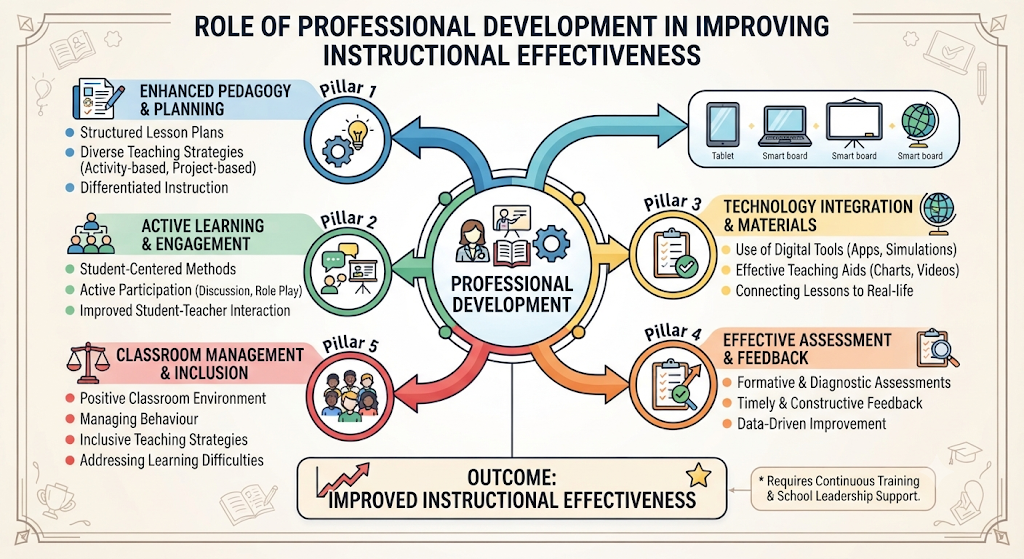
Professional development improves assessment practices. Effective instruction requires continuous understanding of students’ learning progress. Teachers are trained in formative assessment, diagnostic assessment, rubrics, oral questioning, worksheets, project evaluation, peer assessment, and feedback techniques. Good assessment helps teachers identify learning gaps and modify instruction accordingly.
Feedback is a very important part of instructional effectiveness. Professional development helps teachers provide timely, specific, constructive, and encouraging feedback. Instead of only marking answers right or wrong, effective feedback explains mistakes and guides improvement. Students learn better when they understand how to improve their performance.
Professional development also encourages reflective teaching. Reflective teachers think about what worked well in the classroom and what needs improvement. They analyse student responses, classroom challenges, assessment results, and their own teaching methods. Reflection helps teachers continuously improve their instructional practices.
Teacher confidence also increases through professional development. When teachers learn new methods and practise them, they feel more confident in handling classroom situations. Confidence improves teaching clarity, classroom presence, decision-making, and interaction with students. A confident teacher creates a positive learning environment.
Professional development also helps teachers connect teaching with real-life situations. Students understand better when lessons are linked with their daily experiences. Training programmes encourage teachers to use examples from students’ surroundings, local environment, current events, and practical situations. This makes learning meaningful and applicable.
Collaboration among teachers improves instructional effectiveness. Professional development programmes often provide opportunities for teachers to share experiences, discuss classroom problems, and learn from one another. Peer observation, group planning, mentoring, and professional learning communities help teachers improve their practices collectively.
Professional development also helps teachers address learning difficulties. Some students may struggle due to weak basics, low motivation, poor attendance, language problems, or emotional issues. Training helps teachers identify such difficulties early and provide remedial support. Remedial teaching, extra practice, counselling referral, and individualized attention improve learning outcomes.
In educational institutions, instructional effectiveness also depends on curriculum understanding. Teachers must understand curriculum goals, competency requirements, learning outcomes, and assessment patterns. Professional development helps teachers align teaching methods with curriculum expectations. This ensures that classroom teaching supports desired educational goals.
Professional development encourages innovation in teaching. Teachers who attend training become more open to new ideas and experiments. They may use storytelling, games, projects, debates, experiments, field visits, digital tools, and creative assignments. Innovative teaching keeps students interested and improves learning quality.
However, professional development improves instructional effectiveness only when it is practical and continuous. One-time training may not be enough. Teachers need follow-up support, classroom observation, mentoring, feedback, and opportunities to practise new methods. Training should be connected with real classroom challenges.
School leadership also plays a major role. Principals and administrators should provide time, resources, encouragement, and monitoring for teachers to apply new learning. If teachers attend training but do not receive support in school, the impact may remain limited.
Impact of Teacher Training on Student Learning Outcomes#
Teacher training has a direct and meaningful impact on student learning outcomes because teachers are the main facilitators of classroom learning. Student learning outcomes refer to the knowledge, skills, attitudes, understanding, values, and academic performance achieved by students through the teaching-learning process. These outcomes may be measured through examination results, classroom participation, conceptual clarity, problem-solving ability, creativity, communication skills, confidence, and overall academic growth.
A well-trained teacher is more capable of understanding the learning needs of students and selecting suitable teaching methods. When teachers receive professional training, they learn how to explain concepts clearly, use examples effectively, ask meaningful questions, and provide proper feedback. These practices help students understand lessons better and improve their academic performance.
Teacher training improves students’ conceptual understanding. In many classrooms, students may memorize answers without understanding the meaning of concepts. Trained teachers use activity-based learning, experiments, demonstrations, visual aids, storytelling, projects, and real-life examples to make concepts clear. When students understand the subject deeply, they perform better in examinations and are able to apply knowledge in practical situations.
Teacher training also improves student engagement. Trained teachers know how to make lessons interesting and interactive. They use group activities, discussions, quizzes, role play, worksheets, digital tools, and classroom games to involve students actively. Engaged students pay more attention, ask questions, complete assignments, and participate in learning activities. This active participation improves learning outcomes.
Student motivation is also strengthened through trained teachers. A teacher who understands child psychology and classroom motivation can encourage students positively. Appreciation, constructive feedback, encouragement, and supportive communication help students develop confidence. Motivated students show greater effort, regularity, and interest in studies.
Teacher training improves classroom assessment practices. Assessment is not only for giving marks; it is also a tool for identifying learning gaps. Trained teachers use formative assessment, oral questioning, class tests, projects, peer assessment, observation, and feedback to understand students’ progress. When learning gaps are identified early, teachers can provide remedial teaching and help students improve.
Feedback given by trained teachers plays an important role in improving learning outcomes. Effective feedback tells students what they have done well and where they need improvement. Instead of simply marking answers wrong, trained teachers explain mistakes and guide students toward better understanding. This helps students correct errors and improve performance.
Teacher training also supports inclusive learning outcomes. In every classroom, students differ in ability, language, background, learning speed, and emotional needs. Some students may have learning difficulties or disabilities, while others may be advanced learners. Trained teachers use differentiated instruction, peer support, extra time, simplified explanation, assistive technology, and individualized attention to support all learners. This ensures that no student is left behind.
Training helps teachers improve students’ communication skills. Through discussion-based teaching, presentations, group work, reading activities, and questioning techniques, trained teachers encourage students to speak, listen, read, and write more effectively. Communication skills are important learning outcomes in all subjects.
Teacher training also contributes to the development of critical thinking and problem-solving skills. Modern education is not limited to memorization. Students must learn to analyse, compare, reason, question, and solve problems. Trained teachers design activities that require students to think independently and apply knowledge. This improves higher-order learning outcomes.
Digital training for teachers also benefits students. When teachers learn how to use technology effectively, students gain access to videos, simulations, online quizzes, digital assignments, virtual resources, and interactive content. Digital tools make learning more interesting and support visual and auditory learners. Technology also helps students revise and practise beyond classroom hours.
Teacher training improves classroom discipline and learning environment. A well-managed classroom allows students to focus on learning. Trained teachers use positive discipline, clear rules, respectful communication, and student involvement to create a safe classroom atmosphere. A positive environment reduces fear and increases learning confidence.
Learning outcomes also improve when teachers use child-centered methods. Trained teachers understand that students learn better when they are active participants. Instead of only delivering lectures, they encourage students to explore, discuss, experiment, and reflect. Such methods develop deeper learning and long-term retention.
Teacher training also helps reduce dropout and absenteeism. When teaching becomes interesting and supportive, students are more likely to attend school regularly. Students who feel understood and encouraged by teachers develop a stronger attachment to school. Regular attendance improves academic achievement and social development.
Teachers trained in counselling and emotional support can also improve students’ psychological learning outcomes. Many students face stress, fear, low confidence, peer pressure, family problems, or examination anxiety. A trained teacher can identify such problems and provide guidance or referral support. Emotional stability supports better learning.
Teacher training also promotes value-based learning. Teachers are responsible not only for academic instruction but also for developing discipline, cooperation, respect, honesty, responsibility, and citizenship values among students. Professional development helps teachers integrate values and life skills into classroom teaching.
Student learning outcomes are also improved through better lesson planning. Trained teachers prepare lessons with clear objectives, activities, teaching aids, assessment methods, and follow-up tasks. Proper planning ensures that classroom time is used effectively and learning goals are achieved.
Teacher training helps teachers use remedial and enrichment activities. Remedial activities support students who are weak in certain topics, while enrichment activities support students who learn quickly and need advanced challenges. This balanced approach improves outcomes for different learner groups.
Parental involvement may also improve through trained teachers. Teachers who receive training in communication and school-community partnership can interact better with parents. They can guide parents about students’ progress, study habits, attendance, and emotional needs. Parent-teacher cooperation strengthens learning outcomes.
Teacher training also improves professional attitude. Trained teachers become more reflective, patient, flexible, and student-centered. They understand that student failure may not always be due to lack of ability; it may also be due to teaching methods, learning environment, emotional problems, or lack of support. This understanding helps teachers respond more positively to students.
However, the impact of teacher training on student learning outcomes depends on the quality of training. If training is only theoretical, short-term, or unrelated to classroom problems, its impact may remain limited. Effective training should be practical, continuous, subject-based, and supported by mentoring and classroom follow-up.
School support is also necessary. Teachers need resources, time, leadership support, teaching materials, technology, and encouragement to apply training in classrooms. Without institutional support, even trained teachers may find it difficult to improve student learning outcomes.
Challenges and Measures for Strengthening Teacher Professional Development Programmes#
Teacher professional development programmes are essential for improving teaching quality, instructional effectiveness, and student learning outcomes. However, the success of these programmes depends on their planning, relevance, implementation, follow-up, and classroom application. In many educational institutions, professional development programmes are organized regularly, but their actual impact on classroom teaching may remain limited due to several challenges. Therefore, it is important to identify these challenges and suggest suitable measures for strengthening teacher professional development.
One major challenge is that many teacher training programmes are too theoretical. Teachers may attend lectures, listen to presentations, and receive general information, but they may not get enough practical guidance on how to apply new methods in the classroom. If training does not include demonstrations, practice sessions, classroom examples, lesson planning, and hands-on activities, teachers may find it difficult to use the training in real teaching situations.
Another challenge is lack of need-based training. Teachers teach different subjects, classes, age groups, and learner categories. Their challenges may also differ. For example, a primary teacher may need training in foundational literacy and numeracy, while a secondary teacher may need subject-specific pedagogy. Some teachers may need training in inclusive education, while others may need digital teaching skills. If the same training is given to all teachers without assessing their needs, it may not be effective.
Short duration of training is also a problem. Many professional development programmes are conducted for one or two days only. Such short-term programmes may create awareness but may not lead to deep professional change. Teachers need continuous learning, repeated practice, mentoring, feedback, and follow-up support to improve their classroom practices.
Lack of follow-up is another serious challenge. After training, teachers often return to their schools without any monitoring or support. No one may observe whether they are applying new methods or facing difficulties. Without follow-up, professional development remains incomplete. Teachers need classroom observation, peer discussion, mentoring, and feedback after training.
Workload is also an important barrier. Teachers already handle teaching duties, lesson planning, assessment, records, administrative work, examination duties, and co-curricular responsibilities. Due to heavy workload, they may not get enough time to attend training seriously or apply new strategies in the classroom. Professional development should therefore be planned in a way that does not overburden teachers.
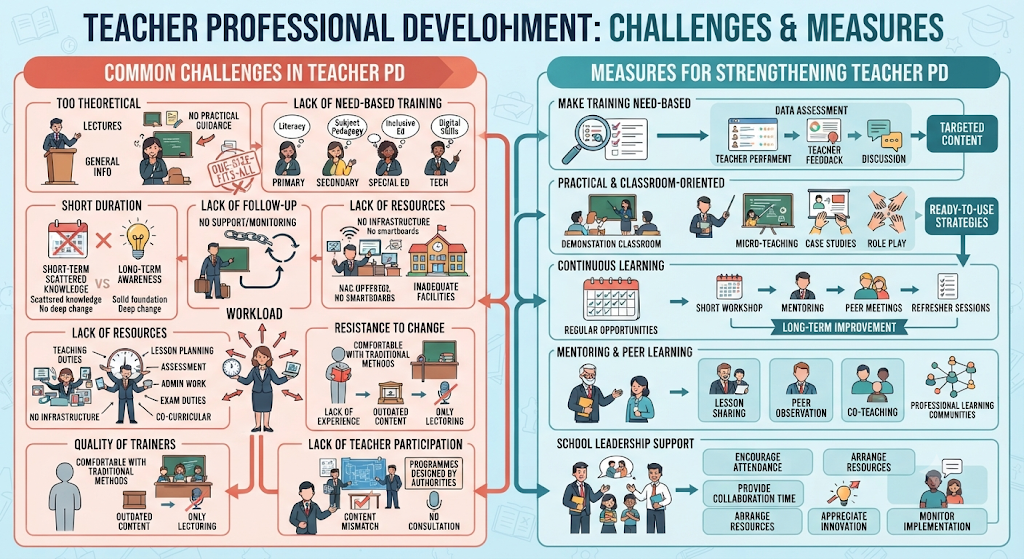
Lack of resources also affects professional development. Teachers may learn about digital tools, activity-based learning, laboratory work, inclusive teaching aids, or project-based learning during training, but their schools may not have proper infrastructure, internet, smart boards, teaching materials, laboratories, libraries, or assistive devices. Without resources, trained teachers may not be able to implement what they have learned.
Resistance to change is another challenge. Some teachers may be comfortable with traditional teaching methods and may hesitate to adopt new approaches. They may feel that innovative methods take more time or disturb classroom discipline. Professional development must therefore motivate teachers and help them understand the practical benefits of new teaching methods.
Quality of trainers is also important. If trainers are not experienced, updated, or connected with classroom realities, the training may not be useful. Trainers should understand school-level challenges and provide practical solutions. They should use interactive methods rather than only delivering lectures.
Another problem is lack of teacher participation in planning professional development. Often, training programmes are designed by authorities without consulting teachers. As a result, the content may not match classroom needs. Teachers should be involved in identifying training needs, designing modules, and evaluating the usefulness of programmes.
To strengthen teacher professional development, the first measure is to make training need-based. Before organizing training, schools and education departments should assess teachers’ needs through surveys, classroom observation, student performance data, teacher feedback, and discussion meetings. Training should be planned according to actual classroom challenges.
Second, professional development should be practical and classroom-oriented. It should include model lessons, teaching demonstrations, micro-teaching, lesson planning, group activities, case studies, role play, digital practice, and problem-solving sessions. Teachers should leave the programme with ready-to-use classroom strategies.
Third, professional development should be continuous rather than one-time. Teachers need regular opportunities for learning throughout the academic year. Short workshops should be followed by mentoring, peer meetings, classroom observation, refresher sessions, and online support. Continuous professional development creates long-term improvement.
Fourth, mentoring and peer learning should be promoted. Experienced teachers can guide new teachers, and teachers can learn from one another through lesson sharing, peer observation, co-teaching, and professional learning communities. Peer learning is useful because it is based on real classroom experience. Fifth, school leadership should support professional development. Principals and administrators should encourage teachers to attend training, provide time for collaboration, arrange resources, appreciate innovation, and monitor classroom implementation. Leadership support is essential for converting training into classroom improvement.
Conclusion#
The study concludes that teacher professional development programmes play a significant role in improving instructional effectiveness and student learning outcomes. Teachers are central to the success of any educational system, and their continuous professional growth is necessary for maintaining quality education. Through workshops, refresher courses, mentoring, peer learning, digital training, and subject-based programmes, teachers can update their knowledge, improve teaching methods, and respond effectively to changing classroom needs.
Professional development strengthens instructional effectiveness by improving lesson planning, classroom communication, use of teaching-learning materials, assessment practices, feedback methods, classroom management, and inclusive teaching strategies. A trained teacher is better able to make learning clear, meaningful, interactive, and student-centered. The study also highlights that teacher training positively influences student learning outcomes. When teachers adopt improved teaching strategies, students show better understanding, higher participation, stronger motivation, improved academic performance, and greater confidence. Thus, teacher development and student achievement are closely linked. However, professional development programmes must be practical, need-based, continuous, and supported by follow-up. Short-term, theoretical, and irregular training may have limited impact. Therefore, schools and education authorities should provide regular training, mentoring, resources, leadership support, and opportunities for teachers to apply new methods in classrooms.
Works Cited#
- Avalos, Beatrice. “Teacher Professional Development in Teaching and Teacher Education over Ten Years.” Teaching and Teacher Education, vol. 27, no. 1, 2011, pp. 10–20.
- Borko, Hilda. “Professional Development and Teacher Learning.” Educational Researcher, vol. 33, no. 8, 2004, pp. 3–15.
- Darling-Hammond, Linda. The Right to Learn. Jossey-Bass, 1997.
- Darling-Hammond, Linda, Maria E. Hyler, and Madelyn Gardner. Effective Teacher Professional Development. Learning Policy Institute, 2017.
- Desimone, Laura M. “Improving Impact Studies of Teachers’ Professional Development.” Educational Researcher, vol. 38, no. 3, 2009, pp. 181–199.
- Fullan, Michael. The New Meaning of Educational Change. 5th ed., Teachers College Press, 2016.
- Guskey, Thomas R. “Professional Development and Teacher Change.” Teachers and Teaching, vol. 8, no. 3, 2002, pp. 381–391.
- Hattie, John. Visible Learning. Routledge, 2009.
- Joyce, Bruce, and Beverly Showers. Student Achievement through Staff Development. 3rd ed., ASCD, 2002.
- Kennedy, Mary M. “How Does Professional Development Improve Teaching?” Review of Educational Research, vol. 86, no. 4, 2016, pp. 945–980.
- Lieberman, Ann, and Lynne Miller. Teachers in Professional Communities. Teachers College Press, 2008.
- Marzano, Robert J. Classroom Instruction That Works. ASCD, 2001.
- Mishra, Punya, and Matthew J. Koehler. “Technological Pedagogical Content Knowledge.” Teachers College Record, vol. 108, no. 6, 2006, pp. 1017–1054.
- OECD. Teachers and School Leaders as Lifelong Learners. OECD Publishing, 2019.
- Opfer, V. Darleen, and David Pedder. “Conceptualizing Teacher Professional Learning.” Review of Educational Research, vol. 81, no. 3, 2011, pp. 376–407.
- Shulman, Lee S. “Those Who Understand: Knowledge Growth in Teaching.” Educational Researcher, vol. 15, no. 2, 1986, pp. 4–14.
- Timperley, Helen. Teacher Professional Learning and Development. International Academy of Education, 2008.
- UNESCO. Teacher Policy Development Guide. UNESCO, 2019.
- Villegas-Reimers, Eleonora. Teacher Professional Development: An International Review of the Literature. UNESCO, 2003.
- Vygotsky, Lev S. Mind in Society. Harvard University Press, 1978.
"Influence of Cultural Diversity and Multicultural Education on Social Cohesion and Intercultural Understanding